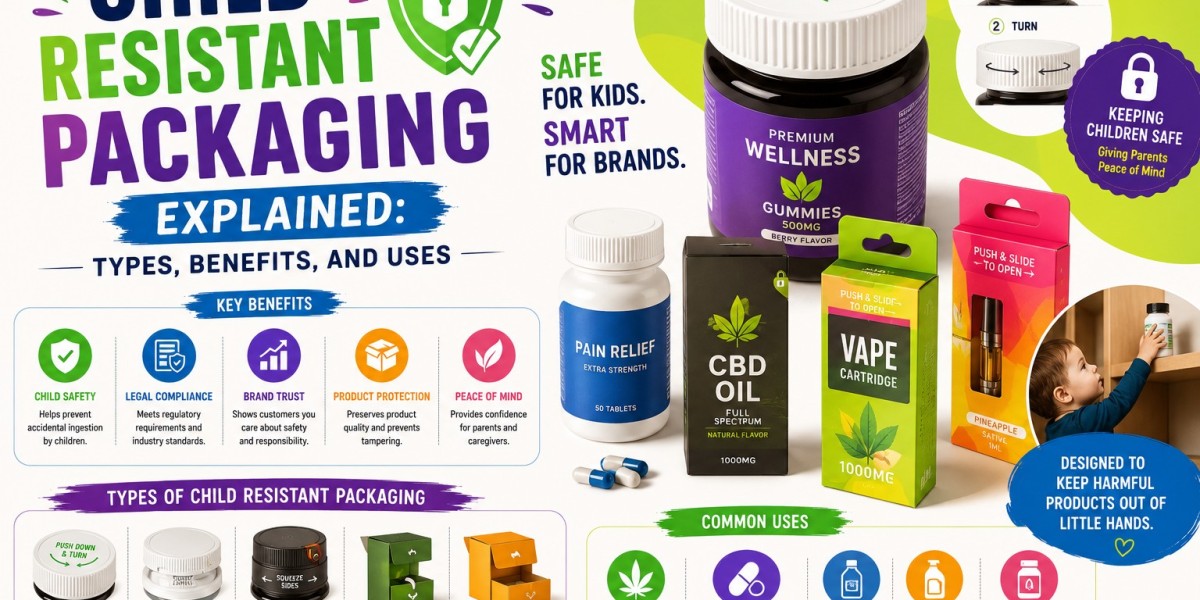

When it comes to packaging products that could be harmful if handled by young children, ordinary packaging is not always enough. A bottle, box, or container may be easy for an adult to open, yet surprisingly tempting and accessible to a curious child. This is where child resistant packaging becomes important.
Child resistant packaging is designed to make it harder for children to open certain products while still allowing adults to access them when needed. It is commonly used for medicines, household chemicals, personal care products, and other items that may pose a risk if swallowed, spilled, or misused.
But child resistant packaging is about more than simply adding a difficult-to-open lid. Its design involves careful consideration of safety, usability, materials, and the way people interact with the package.
What Makes Packaging Child Resistant?
The basic idea is simple: the package should create an additional barrier between a child and the product inside.
A child resistant package is not necessarily impossible for a child to open. Instead, it is designed to make opening sufficiently difficult for young children while remaining reasonably usable for adults. The opening mechanism may require a particular combination of movements, pressure, alignment, or technique.
For example, an adult may need to press down while turning a cap, squeeze specific points on a container, or perform a particular action before the package can be opened.
This extra step can provide valuable time and reduce the likelihood of accidental access.
Common Designs Used in Child Resistant Packaging
Different products require different packaging solutions. Some need a simple closure, while others benefit from a more specialized design.
Press-and-Turn Closures
Press-and-turn caps are among the most familiar examples. The user has to push down on the cap while turning it at the same time.
This two-step movement can be difficult for small children who may not have the strength, coordination, or understanding needed to operate the closure correctly.
These closures are widely associated with medicine bottles and certain household products.
Squeeze-and-Turn Containers
Some packaging uses pressure points that must be squeezed before the cap can be turned or removed.
The design takes advantage of the fact that young children may struggle to apply pressure at the correct locations while performing another movement simultaneously.
Locking Box Systems
Child resistant packaging is not limited to bottles. Folding cartons and specialty boxes can also include locking mechanisms that prevent easy access.
These designs may use internal tabs, locking flaps, or other structures that require a specific opening sequence.
Blister and Unit-Dose Packaging
Certain medicines and small products can be packaged individually. In these systems, the packaging may require the user to perform a deliberate action before the product can be removed.
Unit-dose formats can also help control access because individual items remain separated rather than being immediately exposed inside a larger container.
Reclosable Safety Packaging
Some packages are designed to be closed again after every use. This is particularly useful for products that may be used repeatedly.
A reclosable safety package can help reduce the chance of accidental access between uses, provided that the closure is properly secured each time.
Why Child Resistant Packaging Matters
The main purpose of this type of packaging is accident prevention.
Children naturally explore objects around them. A colorful container, unfamiliar bottle, or interesting-looking box can attract attention even when the contents are dangerous. If the package opens easily, a child may gain access before an adult notices.
A well-designed child resistant package introduces another layer of protection.
It can help:
Reduce the chance of accidental ingestion.
Make access more difficult for young children.
Give adults additional time to intervene.
Provide a safer way to store potentially hazardous products.
Support responsible handling of medicines and household substances.
Packaging should never be treated as the only safety measure. Safe storage, proper labeling, supervision, and responsible use remain equally important.
Products That Commonly Use This Packaging
Child resistant packaging is used across several industries because many everyday products can become dangerous when they are used incorrectly.
Medicines and Healthcare Products
Medicines are one of the most recognizable applications. Tablets, capsules, liquid medicines, and other pharmaceutical products may require packaging that reduces the risk of children accessing them.
Since medication can cause serious harm when taken accidentally or in the wrong quantity, packaging plays an important supporting role in safe storage.
Household Cleaning Products
Cleaning products can contain ingredients that should not be swallowed or exposed to the skin or eyes.
Special closures and containers can make these products more difficult for children to access and can complement clear warning labels.
Personal Care Items
Certain personal care and cosmetic products may also require additional protection depending on their ingredients and intended use.
Packaging can be designed to discourage young children from opening products that are not meant for them.
Garden and Outdoor Products
Some gardening and outdoor-use products require controlled access because of their chemical contents. Child resistant packaging can provide an additional barrier during storage and everyday handling.
Benefits Beyond Basic Safety
The biggest advantage is, of course, reducing the likelihood of accidental access. But there are several other practical benefits.
A Better Balance Between Safety and Convenience
A package that is extremely difficult for everyone to open may create frustration. Good child resistant packaging aims for a balance: difficult enough to discourage young children but practical enough for responsible adult users.
This balance is particularly important for products that people need to access regularly.
Added Protection During Everyday Storage
People do not always store products in ideal conditions. A safety-oriented closure provides another layer of protection when a container is accidentally left within a child's reach.
It should still be stored safely, but the packaging can reduce the consequences of an oversight.
Greater Consumer Confidence
Packaging that clearly communicates safety features can reassure consumers that the manufacturer has considered how the product may be handled in a household environment.
This can be especially valuable for products used around children.
Child Resistant Does Not Mean Childproof
One of the most important points to understand is the difference between "child resistant" and "childproof."
Child resistant packaging is designed to make access more difficult for children. It is not an absolute guarantee that a child will never succeed in opening it.
With enough time, experimentation, or repeated attempts, a child may eventually figure out a mechanism.
For that reason, potentially dangerous products should still be kept out of children's reach and preferably stored in a secure location.
The packaging is an extra line of defense—not a replacement for careful storage.
What Manufacturers Consider When Designing It
Creating effective child resistant packaging requires more thought than simply making a closure harder to turn.
Manufacturers may consider the strength and coordination needed to operate the package, the number of steps involved, the type of material being packaged, how frequently consumers need access, and whether adults can understand the opening instructions.
The package also needs to remain functional throughout its intended life. A closure that works perfectly when new but becomes unreliable after repeated use would not be a practical solution.
For regulated products, manufacturers may also need to meet applicable safety and performance requirements in the markets where the products are sold.
Choosing the Right Packaging for a Product
There is no single child resistant package that works for every product.
The right choice depends on factors such as the product's physical characteristics, potential hazards, container size, expected usage, storage conditions, and target market.
For products used frequently, convenience may be especially important. For products that present a higher risk if accessed accidentally, stronger access-control features may be appropriate.
The goal is to find a design that protects the product and the people around it without making normal adult use unnecessarily complicated.
The Bigger Role of Packaging in Product Safety
Packaging is often the first physical barrier between a product and its surroundings. Its job can include much more than protecting contents from damage.
Modern packaging can help with identification, storage, transportation, tamper awareness, dosage control, and controlled access. Child resistant features fit into this broader role by addressing one specific concern: preventing young children from gaining easy access to products that could harm them.
When combined with responsible storage and clear product information, these features can make everyday products safer to handle.
Final Thoughts
Child resistant packaging provides a practical layer of protection for products that should not be easily accessible to young children. From press-and-turn medicine caps to locking cartons and specialized containers, different designs are available for different needs.
Its effectiveness depends not only on the closure itself but also on thoughtful design, correct use, and responsible storage. For manufacturers, choosing the right packaging means considering safety, usability, product requirements, and applicable regulations together.
For consumers, the key takeaway is simple: child resistant packaging can reduce risk, but it should never replace safe storage and careful handling. Used together, these measures create a much stronger approach to protecting children from accidental access to potentially harmful products.