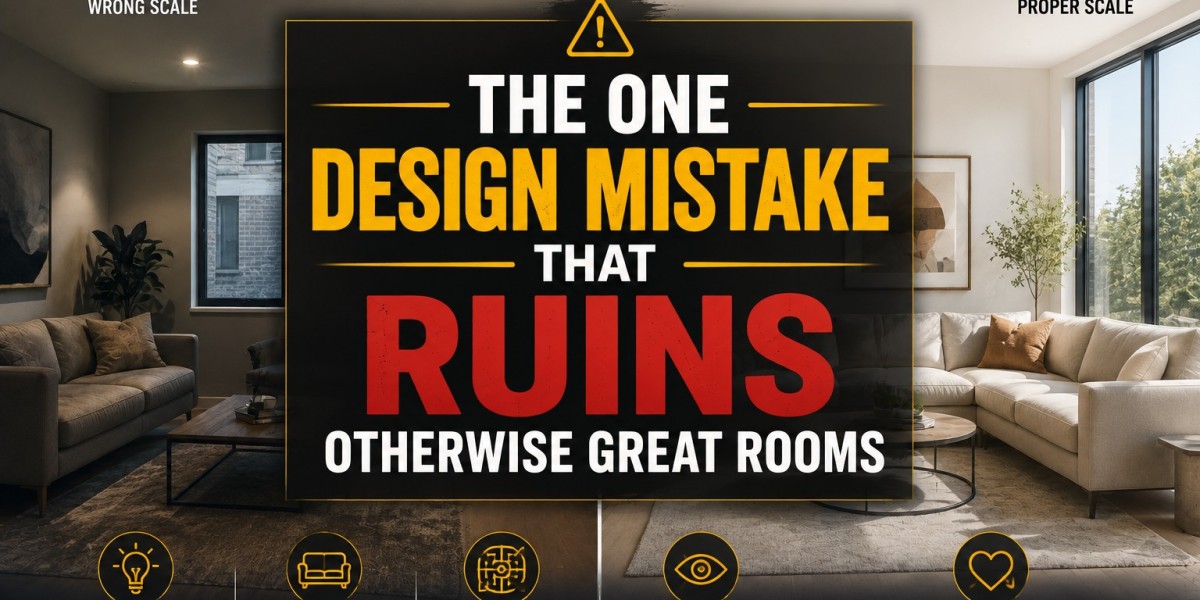

Almost every homeowner who's ever painted a "statement wall" has a version of the same regret story. They fell in love with a paint swatch, a stone sample, or a wallpaper pattern in the store, brought it home, applied it to an entire wall and then stood back wondering why it looked nothing like they imagined. The color was too dark for the room's light. The texture clashed with the furniture. The pattern that looked subtle on a 4x4 sample suddenly felt overwhelming across twelve feet of wall.
This isn't bad taste. It's a scale and lighting problem, and it's one of the most common ways a well-intentioned design decision goes wrong.
Why Small Samples Lie
A paint chip or a tile sample is designed to show you color and texture in isolation. What it can't show you is how that material behaves across a full wall, under your specific lighting, next to your specific furniture and flooring. A rich navy that looks moody and sophisticated on a swatch can turn the whole room dark and closed-in once it covers sixty square feet. A busy geometric pattern that reads as playful in a small square can feel chaotic once it dominates an entire sightline.
This gap between "sample" and "reality" is exactly why so many accent wall projects get repainted within a year of being finished.
Rethinking the Planning Process
Seeing the Whole Wall, Not a Swatch of It
The obvious fix is to stop making decisions based on small samples and start seeing the actual wall, at actual scale, in the actual room. Digital visualization tools have made this dramatically easier than it used to be. Instead of guessing how a material will look once it's fully applied, a designer or homeowner can now see a rendered version of the entire wall with the same dimensions, same lighting conditions, same surrounding furniture before anything gets purchased or installed.
Testing Light at Different Times of Day
Lighting is the variable most people forget to account for. A wall that looks warm and inviting under the afternoon sun can look flat and cold once the sun goes down and artificial lighting takes over. Materials with any kind of texture stone, wood, textured paint behave especially unpredictably under changing light, since shadows shift and surface detail either pops or disappears depending on the angle and intensity of the light source.
Comparing Options Side by Side Instead of One at a Time
One of the biggest advantages of planning digitally rather than physically is the ability to compare multiple options against the same space without committing to any of them. A textured paint finish, a stacked stone look, and a wood panel treatment can all be viewed in the same rendered room, under the same lighting, which makes it far easier to spot which option actually complements the space rather than fighting against it.
Where People Get This Wrong Most Often
A few patterns show up again and again in accent wall regrets:
Choosing color in isolation picks a shade that looks great on its own but clashes with existing flooring, trim, or furniture once it's actually installed.
Underestimating pattern intensity a geometric or abstract pattern that feels bold and intentional in a small dose can overwhelm a full wall.
Ignoring room function, a stimulating, high-contrast wall might energize a home office but work against the calm a bedroom is supposed to provide.
Skipping the "at scale" step entirely moving straight from a small sample to a fully finished wall with nothing in between to catch a mismatch.
Getting the Full Picture Before Committing
The projects that turn out well tend to share one habit: someone slowed down long enough to see the design at full scale before it became permanent. For anyone curious about exactly how this kind of visualization process works and how it's specifically applied to feature and accent walls, this guide on using 3D visualization for accent wall design walks through the materials, patterns, and planning approach in detail.
Final Thoughts
An accent wall is one of the most affordable ways to transform a room, but it's also one of the easiest design choices to get wrong precisely because a small sample almost never predicts the full-scale result. Taking the extra step to see the material at true scale, under real lighting, before committing to it is the difference between a wall people love for years and one that gets repainted within a season.