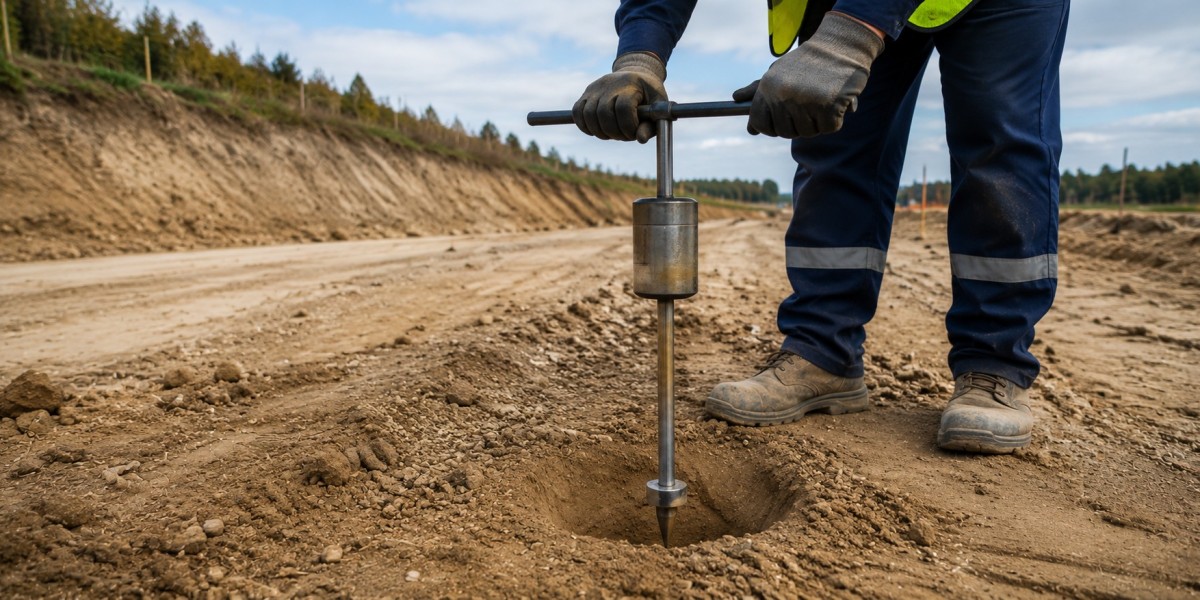

Geotechnical evaluation forms the backbone of modern civil engineering, infrastructure design, and structural development. Before pouring foundations or laying asphalt, site engineers must understand the mechanical properties of underlying soil layers. Evaluating in situ subgrade parameters ensures long term stability and mitigates catastrophic settlement risks. Without proper ground investigation, structural failures and costly redesigns become almost inevitable.
Among various site investigation tools, portable dynamic penetrometers provide rapid data acquisition directly in the field. Traditional core sampling followed by laboratory testing requires extensive time, specialized logistics, and significant financial investment. In contrast, portable dynamic field testing delivers immediate results right at the project site. This immediate feedback enables engineering teams to make instant adjustments to earthworks, compaction protocols, and foundation depths.
Modern soil assessment relies heavily on standardized field instruments manufactured by industry specialists like Labquip Ltd. Selecting robust equipment allows geotechnical professionals to conduct the dynamic cone penetration dcp test across diverse site conditions efficiently. By utilizing precise instruments supplied by Labquip Ltd, field teams obtain dependable penetration index values that directly correlate with soil bearing capacity and structural modulus.
Fundamental Principles of Dynamic Cone Penetration Testing
The primary operational concept behind dynamic penetration testing is straightforward yet remarkably accurate. The procedure involves dropping a standardized drop weight from a fixed height onto an anvil assembly connected to a steel drive rod. At the lower tip of this rod is a hardened steel cone driven directly into the ground. As the weight impacts the anvil, kinetic energy drives the cone into subgrade layers, measuring resistance continuous through depth profile.
Engineers calculate soil strength by measuring penetration depth per blow, typically expressed in millimeters per blow. Harder, densely compacted subgrade materials yield small penetration depths per impact blow, signaling high shear strength and heavy load bearing capabilities. Soft or loose subgrades experience higher penetration per blow, indicating low structural capacity and weak compaction. This quantitative metric allows immediate identification of weak strata down to desired investigation depths.
Standardizing apparatus specifications ensures test repeatability across multiple project locations. Standard equipment configurations feature an 8 kg drop hammer falling through a controlled distance of 575 mm onto a 60 degree cone tip. These standardized dimensions make dynamic testing an international benchmark for flexible pavement design, subbase compaction checks, and earthwork validation. Consistent instrument calibration guarantees that field measurements translate into reliable structural engineering metrics.
Key Components of Dynamic Cone Penetrometer Apparatus
Understanding the constituent parts of a dynamic penetrometer helps technicians maintain accuracy during field operations. Premium testing equipment provided by Labquip Ltd consists of precision engineered components designed to withstand repeated dynamic forces. Every single element plays a crucial role in delivering uniform dynamic energy into the underlying subgrade.
The top assembly includes a handle coupled to a precision guide rod. An 8 kg drop hammer slides along this guide shaft smoothly, coming into direct contact with the lower anvil upon release. The anvil absorbs repeated impact force and transfers kinetic energy down through connected extension rods. Heavy duty threads secure these sectional drive rods, allowing smooth vertical assembly without lateral deflection during penetration.
At the leading edge of the assembly lies the penetrometer tip, available in fixed cone or disposable cone configurations. A vertical scale or vertical measuring rod runs parallel to drive shafts, enabling operators to record incremental depth changes accurately after every single blow or series of blows. High grade alloy steel construction prevents tip deformation when encountering hard aggregate layers, preserving measurement accuracy over extended field deployment.
Step by Step Method for Conducting Field Tests
Preparing for field execution requires verifying that testing hardware is fully clean, correctly threaded, and straight. Technicians position the assembly vertically over the designated site location, ensuring vertical alignment throughout testing. Operating the instrument standardly requires a two person field crew: one operator lifts and releases the drop weight while a second technician logs penetration depths on standardized recording sheets.
Testing commences by lifting the drop weight until it makes gentle contact with the upper stop before allowing a clean free fall onto the anvil. Operators record initial seating readings after the first few impacts to establish baseline alignment. Following seating blows, technicians drop the weight continuously, logging total cumulative penetration after specific blow counts or recording total blows required to penetrate set depth increments.
Continuous logging reveals layer boundaries, transitions between materials, and localized soft pockets buried beneath dense surface subbases. Field testing proceeds until reaching desired investigation depths or achieving target refusal limits in extremely hard strata. Promptly cleaning drive rods after extraction prevents fine soil particle build up, extending instrument operational longevity across demanding field campaigns.
Applications in Pavement Design and Road Construction
Road construction represents one of the largest application areas for dynamic penetrometer testing. Pavement longevity depends directly on uniform subgrade support underneath structural binder and surface courses. By performing rapid dynamic testing across proposed roadway alignments, engineers establish reliable structural profiles along miles of planned infrastructure.
In subbase evaluation, penetrometer data directly translates into California Bearing Ratio values through validated empirical relationships. Highway designers use these empirical correlations to determine necessary asphalt thickness, aggregate base requirements, and soil stabilization needs. Identifying weak subgrade zones prior to paving prevents premature rutting, fatigue cracking, and costly road rehabilitation work.
Unbound granular material testing benefits significantly from dynamic penetration analysis. Quality control managers deploy penetrometers directly on freshly compacted soil layers to confirm compaction density goals. By comparing field penetration rates against specified target values, site supervisors give instant approval for subsequent lift placement or request immediate re compaction.
Geotechnical Site Investigation and Foundation Assessment
Geotechnical site investigations demand accurate soil profiling to assess foundation stability for light structures, industrial slabs, and utility installations. Dynamic penetrometer equipment allows geotechnical specialists to screen large construction footprints quickly. Identifying variability in soil layer strength helps engineers optimize borehole location planning, saving client resources.
Evaluating existing foundation subgrades during structural renovations requires non destructive or minimally invasive testing techniques. Dynamic penetrometers require minimal surface access, penetrating narrow drill holes or small asphalt corings effortlessly. Engineers evaluate soil conditions beneath existing concrete slabs without incurring severe structural disturbance or massive site restoration costs.
Utility trench backfilling requires strict adherence to compaction specifications to avoid post construction ground subsidence. Dynamic testing provides immediate confirmation that backfill materials meet shear strength requirements from trench bottom up to finished grade. Contract managers rely on documented penetrometer profiles to verify compliance with local municipal engineering standards.
Converting Penetration Index to Engineering Parameters
Field test data produces a primary metric known as the penetration index, usually expressed in millimeters per blow. While raw penetration rates offer valuable comparative insights, civil engineers convert these measurements into established mechanical properties for structural calculation. Standardized empirical formulas transform penetration index values into equivalent California Bearing Ratio percentages.
Relationships established by international transportation authorities allow seamless transformation of penetration rates into resilient modulus estimates. Structural pavement design software accepts these converted values directly, enabling pavement engineers to calculate exact layer coefficients. Accurate parameter estimation eliminates guesswork, preventing both over engineering and structural under design.
Correlation equations vary depending on soil type, such as cohesive clays versus non cohesive granular sands. Soil specialists adjust empirical conversion factors based on local site geology and moisture conditions. Utilizing dedicated software utilities alongside quality hardware from Labquip Ltd accelerates data reduction, generating comprehensive engineering graphics for client submittals.
Advantages of Portable Dynamic Testing Equipment
Portability serves as a dominant advantage when choosing dynamic penetrometer tools over heavy drilling rigs. Compact design allows field crews to transport entire assemblies in standard vehicle trunks or rugged carry cases. Remote project locations, steep embankments, and confined indoor spaces become completely accessible without heavy machinery support.
Speed of execution significantly lowers site operational overhead. Performing a complete dynamic test down to one meter depth typically requires less than ten minutes per location. Rapid data turnaround allows engineering teams to perform dozens of tests per workday, mapping spatial strength variation across extensive construction footprints with minimal downtime.
Financial economy reinforces dynamic testing as an essential site investigation tool. Capital investment in high quality testing apparatus from Labquip Ltd pays off quickly through reduced laboratory testing bills and accelerated project schedules. Simple mechanical construction minimizes maintenance overhead, making dynamic penetrometers reliable workhorses for field operations.
Calibration and Maintenance of Testing Hardware
Maintaining equipment accuracy demands routine inspection and preventive maintenance protocols. Dynamic impacts generate high mechanical stress, making periodic checks of threaded couplings, guide bars, and drop weight tolerances essential. Inspecting drive rods for straightness prevents erroneous friction readings caused by rod bending against borehole walls.
Cone tip wear represents a critical factor affecting test data validity. Repeated driving into abrasive soils blunts sharp tip geometries, artificially increasing recorded penetration resistance. Technicians must check cone dimensions using precision calipers against manufacturing tolerances supplied by Labquip Ltd, replacing worn tips immediately when dimensional limits are exceeded.
Proper cleaning after field deployment protects mechanical components from premature corrosion and wear. Removing soil fines, wiping steel surfaces with protective oil, and storing apparatus components in protective carrying cases preserves instrument precision. Scheduling periodic formal factory calibration with accredited suppliers ensures compliance with international testing standards.
Frequently Asked Questions
What depth can a standard dynamic cone penetrometer reach?
Standard field setups reliably investigate soil strength down to depths between 1 meter and 2 meters. Utilizing specialized rod extensions allows deeper profiling in favorable soil conditions, provided side friction along drive shafts remains minimal.
How does moisture content affect test penetration results?
Moisture content influences soil shear strength significantly. Elevated moisture levels generally reduce soil suction and effective stress, leading to higher penetration rates per blow. Engineers consider seasonal groundwater fluctuations when interpreting penetration profiles.
Can dynamic penetrometers replace soil laboratory testing entirely?
While dynamic penetrometers provide excellent continuous subgrade strength profiles, they complement rather than replace comprehensive laboratory soil classification. Laboratory tests establish baseline index properties, whereas dynamic penetrometers deliver rapid in situ strength verification across large site footprints.
What is the main difference between fixed and disposable cone tips?
Fixed cone tips are permanently attached to lower drive rods and retrieved after test completion in soft to medium soils. Disposable cone tips sit loosely on drive adapters and remain underground upon rod extraction, making rod recovery easier in dense soils.
Why is standard drop hammer weight critical for test accuracy?
Standardized 8 kg hammer weight dropped from 575 mm ensures reproducible kinetic energy delivery during every impact stroke. Deviations in drop height or weight invalidate empirical conversion formulas used to estimate bearing capacity metrics.
Conclusion
Dynamic penetration testing provides engineers with a rapid, accurate, and cost effective solution for assessing subgrade strength across diverse civil engineering projects. By delivering continuous strength measurements with depth, this testing methodology empowers project teams to identify weak soil zones, verify compaction quality, and optimize pavement designs efficiently. Partnering with established equipment providers such as Labquip Ltd guarantees access to high precision penetrometers, full calibration support, and expert guidance. Incorporating standardized dynamic field testing into quality control protocols ensures long term structural integrity and foundation stability for modern infrastructure investments.