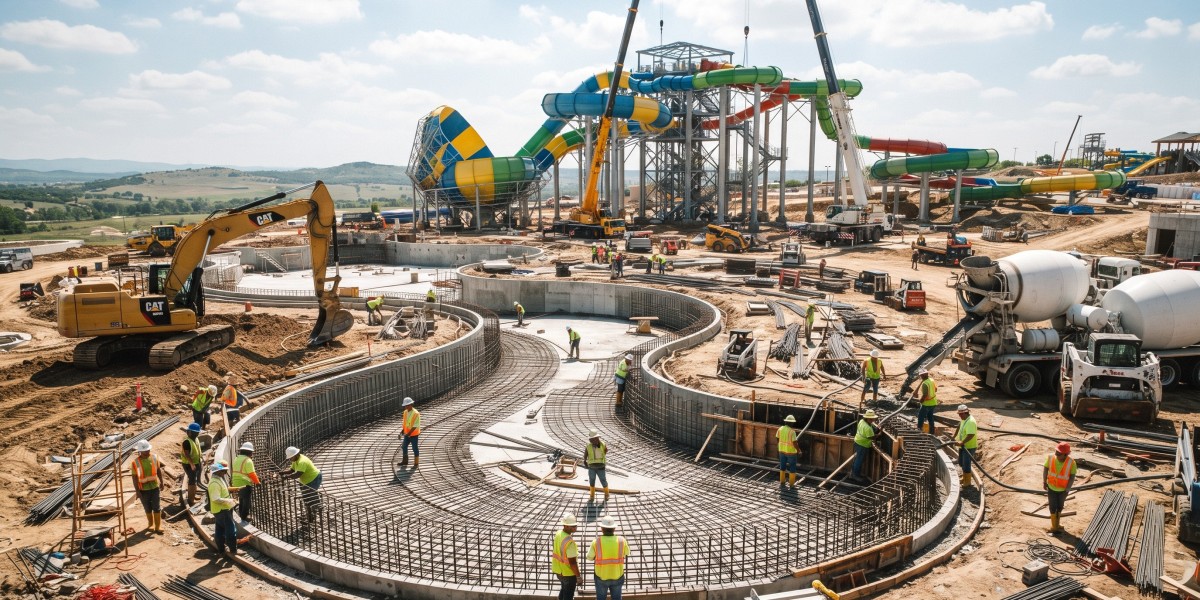

Developing a commercial aquatic facility demands precise engineering, strict adherence to safety standards, and specialized structural planning. Unlike standard residential swimming installations, large scale public and resort aquatic projects must endure heavy daily swimmer loads, continuous chemical processing, and rigorous municipal health codes.
Commercial aquatic construction starts with comprehensive environmental testing and site evaluations. Hydraulic design engineers assess soil conditions, municipal water supply capacity, drainage infrastructure, and localized zoning regulations before drawing up initial blueprints.
Site Evaluation and Engineering Fundamentals for Aquatic Venues
Before breaking ground on any commercial swimming facility, master engineers conduct extensive soil testing and structural feasibility studies. Subsurface geotechnical factors like expansive soil types, high water tables, and natural bedrock determine the necessary structural depth, steel rebar grid density, and concrete thickness.
Hydraulic design forms the core operational foundation of any commercial swimming venue. Project engineers create specialized piping layouts that prevent stagnant zones, maintain balanced water turnover, and minimize hydraulic head loss.
Design for Volume, Not Just Appearance
A commercial aquatic facility must be designed around how people move through it. The pool needs to accommodate expected visitor volume while maintaining usable circulation areas and appropriate separation between different activities.
A successful design considers where people enter and exit the water, where they gather, how staff monitor the area, and how different attractions interact. A visually impressive pool that creates congestion or difficult staff visibility will not perform well as a commercial facility.
Separate Different Aquatic Experiences
Water parks often contain several types of aquatic spaces. A family play area may have different requirements from a deeper recreational pool, lazy river, wave feature, or competitive swimming area. Separating activities can help make the facility easier to manage and more comfortable for visitors.
Mission Pools describes its commercial work as including water parks, Olympic swimming pools, community pools, and other large scale aquatic facilities. Each type of facility requires its own approach rather than simply increasing the size of a residential pool design.
Work With a Team Experienced in Large Aquatic Projects
Large scale aquatic construction requires experience with projects that are significantly different from residential installations. The design team needs to understand scale, coordination, technical systems, and the operational needs of the finished facility.
Mission Pools states that it has worked with communities, developers, and institutions on large scale aquatic projects and has experience with water parks and Olympic facilities.
Organizations exploring water park pool construction should therefore evaluate a contractor's commercial portfolio, technical capabilities, project management, and long term support.
Build the Mechanical Infrastructure Around the Usage
High bather loads place greater demands on circulation, filtration, sanitation, and water management systems. Equipment must be selected according to the scale and expected use of the facility.
The system needs to maintain water quality while operating consistently during busy periods. Access for inspection and servicing is also essential.
Equipment rooms should be considered part of the facility design rather than hidden technical spaces added at the end of the project.
Plan for Safety From the Beginning
Safety cannot be treated as a final inspection item. It needs to influence layout, circulation, visibility, access, surfaces, depth transitions, signage, barriers where applicable, and staff operations. Different aquatic areas may require different safety considerations.
A shallow children's zone, deep recreational pool, and high speed attraction do not present identical conditions. Design teams should coordinate applicable requirements and local regulations throughout the planning and construction process.
Construction Requires Multiple Specialized Trades
Large aquatic projects can involve excavation, structural reinforcement, plumbing, electrical systems, gas, shotcrete, tile, masonry, mechanical equipment, and other specialized work.
Mission Pools states that its commercial division includes expertise across excavation, steelwork, plumbing, shotcrete, electrical, gas, tile, masonry, and related construction areas.
Coordination is therefore critical. A problem in one discipline can affect another, especially when construction involves complex water features or large mechanical systems.
Consider Maintenance Before Construction Is Complete
A commercial pool will need ongoing service from the moment it opens. Equipment access, filter servicing, chemical management, drainage, surface cleaning, lighting repairs, and other tasks should be considered during design.
If equipment is difficult to access, routine maintenance becomes harder and potentially more disruptive.
Designers should think about how technicians will actually work in the facility several years after construction, not just how the completed building will look on opening day.
Build for Long Term Commercial Use
Commercial pools experience a different level of wear than residential pools. Surfaces, equipment, plumbing, and finishes can be exposed to constant use during busy periods. Material selection should therefore consider durability and service requirements alongside aesthetics.
A commercial facility is an operating business or public asset. Downtime can affect revenue, visitor satisfaction, schedules, and reputation, so reliability has real financial importance.
Conclusion
A water park pool is an engineered commercial environment, not simply a larger swimming pool. Visitor flow, safety, circulation, filtration, sanitation, equipment access, construction coordination, and long term maintenance all influence the success of the facility.
The most successful projects combine memorable visitor experiences with reliable infrastructure. When those two sides are planned together, a water park can provide exciting attractions while remaining practical to operate and maintain.