
The chemical formula for aluminum sulfide is an important topic in chemistry because it explains the composition, structure, and behavior of this inorganic compound. Aluminum sulfide is formed when aluminum combines chemically with sulfur, producing a compound with specific chemical properties and industrial applications. Understanding its formula helps students, researchers, and chemistry enthusiasts learn how elements combine to form stable compounds. Aluminum sulfide is also known as aluminium sulfide in British English, and both names refer to the same chemical substance. Its properties make it an interesting compound to study, particularly because it reacts with water and can produce hydrogen sulfide gas. Learning about its chemical formula, preparation, characteristics, uses, and safety requirements provides a clearer understanding of its role in inorganic chemistry.
What Is the Chemical Formula for Aluminum Sulfide?
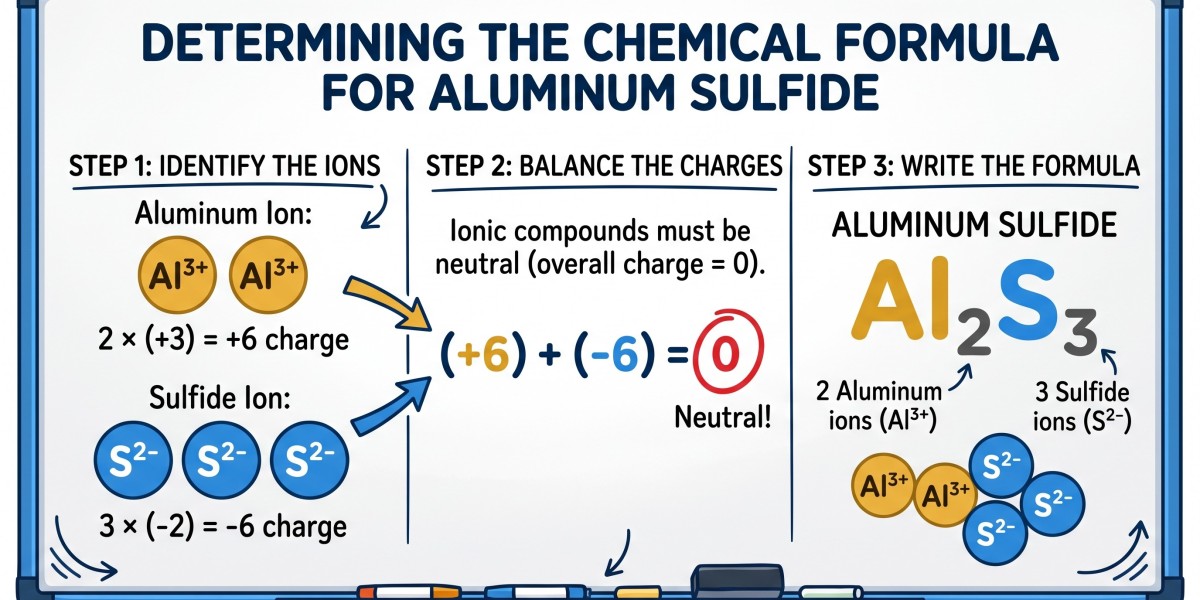
The chemical formula for aluminum sulfide is Al₂S₃. This formula indicates that the compound contains aluminum and sulfur in a fixed proportion, with aluminum atoms and sulfur atoms arranged in a ratio of two to three. Aluminum typically forms positively charged ions with a charge of three, while sulfur forms negatively charged sulfide ions with a charge of two. These opposite charges balance when the ions combine in the correct proportion, producing an electrically neutral compound. The formula represents the simplest whole-number ratio of the elements in aluminum sulfide rather than a separate molecule containing only a small group of atoms. This distinction is important because aluminum sulfide is an ionic solid with a crystal structure.
How Is the Formula of Aluminum Sulfide Determined?
The formula of aluminum sulfide can be determined by considering the charges of aluminum and sulfide ions. Aluminum commonly loses electrons to form Al³⁺ ions, while sulfur gains electrons to form S²⁻ ions. A neutral compound must have an equal total positive and negative charge. Combining two aluminum ions produces a total positive charge of six, while three sulfide ions produce a total negative charge of six. These charges cancel each other, resulting in the formula Al₂S₃. This method is commonly used in chemistry to determine formulas for ionic compounds. Understanding ionic charges makes it easier to identify the correct formula of aluminum sulfide and distinguish it from other compounds containing aluminum or sulfur.
Chemical Composition of Aluminum Sulfide
Aluminum sulfide consists of aluminum and sulfur, which are elements with different chemical properties. Aluminum is a metallic element known for its lightweight nature and ability to form protective oxide layers under suitable conditions. Sulfur is a nonmetal that participates in various chemical reactions and forms sulfide compounds with many metals. When aluminum and sulfur react under appropriate conditions, they form aluminum sulfide through a chemical combination. The resulting compound has properties that differ significantly from those of its individual elements. Its chemical composition influences its reactivity, structure, and behavior when exposed to moisture or other substances. Studying these characteristics helps explain why aluminum sulfide must be handled differently from ordinary aluminum metal or elemental sulfur.
Chemical Structure of Aluminum Sulfide
The chemical structure of aluminum sulfide is based on aluminum and sulfide ions arranged within a solid crystal lattice. Rather than existing primarily as independent molecules, the ions are held together by electrostatic attraction between opposite charges. This arrangement contributes to the compound's physical characteristics and chemical behavior. The distribution of ions within the crystal structure helps maintain electrical neutrality throughout the solid. Its structure also influences how aluminum sulfide interacts with water and other reactive substances. Understanding the difference between an ionic crystal and a molecular compound is important when studying inorganic chemistry. The formula Al₂S₃ expresses the simplest ratio of the constituent ions, while the crystal structure describes how those ions are arranged in the solid material.
Physical Properties of Aluminum Sulfide
Aluminum sulfide is generally described as a solid inorganic compound that can appear yellowish, grayish, or in other shades depending on its purity and physical form. Its appearance alone is not a reliable way to identify it because impurities and preparation conditions can affect its color. The compound is sensitive to moisture and can react when exposed to water, making storage conditions particularly important. Its physical characteristics are influenced by its crystal structure and chemical composition. Unlike many common salts that can be handled in ordinary laboratory conditions, aluminum sulfide requires additional care because contact with moisture can lead to the formation of hazardous hydrogen sulfide gas. Therefore, its physical properties should always be considered together with its chemical reactivity and safety requirements.
Chemical Properties of Aluminum Sulfide
The chemical properties of aluminum sulfide are strongly influenced by the presence of sulfide ions and its sensitivity to moisture. One of its most important reactions occurs when it comes into contact with water, producing aluminum hydroxide and hydrogen sulfide gas. Hydrogen sulfide is toxic and can be dangerous even at relatively low concentrations, so this reaction must not be attempted casually or outside suitable professional controls. Aluminum sulfide can also participate in reactions involving acids and other chemicals, depending on the reaction conditions. Its behavior demonstrates how the chemical properties of a compound differ from the properties of the elements used to form it. Understanding these reactions is essential for chemistry students, laboratory workers, and professionals who may encounter the compound in research or industrial settings.
How Is Aluminum Sulfide Formed?
Aluminum sulfide can be formed through a chemical reaction between aluminum and sulfur under controlled conditions. During this reaction, the elements combine to produce a new substance with a composition represented by Al₂S₃. The process involves changes in electron distribution, with aluminum undergoing oxidation and sulfur undergoing reduction. This makes the reaction an example of a redox process. Although the reaction is a useful educational example of compound formation, actual preparation requires appropriate laboratory equipment, training, and safety controls. The reactants and the resulting material must be handled carefully, particularly because aluminum sulfide reacts with moisture to release toxic gas. For this reason, practical preparation should be carried out only by qualified personnel following an established procedure and suitable risk assessment.
Reaction of Aluminum Sulfide With Water
Aluminum sulfide reacts with water to produce aluminum hydroxide and hydrogen sulfide gas. This reaction is especially important because hydrogen sulfide presents a serious inhalation hazard. The balanced chemical equation is Al₂S₃ + six H₂O → two Al(OH)₃ + three H₂S. The equation shows that water participates in the reaction and that hydrogen sulfide is released as a product. This behavior explains why aluminum sulfide must be protected from moisture during storage and handling. It should never be tested by adding water in an uncontrolled environment. Even when the compound is being studied for educational purposes, its reaction with moisture should be understood primarily as a chemical safety consideration rather than as a casual demonstration.
Industrial Applications of Aluminum Sulfide
Aluminum sulfide has relevance in specialized chemical research and certain industrial investigations involving inorganic sulfide materials. Its chemical composition makes it useful as a subject of study in solid-state chemistry, materials science, and research into reactions between metal compounds and moisture. However, it is not as widely used in everyday consumer products as many common aluminum compounds. Its sensitivity to water and the potential release of toxic hydrogen sulfide limit the situations in which it can be handled conveniently. Industrial use depends on the requirements of a particular process, the purity of the material, and the availability of suitable containment and safety controls. Understanding the compound's properties is therefore important for determining whether it is appropriate for a particular research or manufacturing application.
Importance of Aluminum Sulfide in Chemistry Education
Aluminum sulfide is a useful example for teaching ionic formulas, oxidation states, chemical reactions, and redox principles. Its formula demonstrates how the charges of different ions determine the composition of a neutral compound. Students can use it to understand why the number of atoms represented in an ionic formula is based on charge balance rather than arbitrary selection. The compound also illustrates how a substance formed from familiar elements can have very different properties from those elements. Its reaction with water provides an example of how chemical reactivity can create hazardous products, reinforcing the importance of laboratory safety. Studying aluminum sulfide therefore connects fundamental chemical concepts with practical considerations involving material handling, reaction prediction, and hazard awareness.
Safety Precautions When Handling Aluminum Sulfide
Aluminum sulfide must be handled with care because moisture can cause it to release hydrogen sulfide gas, which is toxic. It should be kept away from water, humid conditions, and incompatible substances, following the supplier's safety data and institutional procedures. Work involving the compound should take place under appropriate professional controls, with suitable protective equipment and ventilation selected through a proper risk assessment. It should never be mixed with water or acids as an informal experiment, and any suspected release of hydrogen sulfide requires an appropriate emergency response. People should not rely on odor to determine whether hydrogen sulfide is present because the sense of smell can become unreliable at dangerous concentrations. Safe storage, trained handling, and established emergency procedures are essential whenever this compound is used.
Difference Between Aluminum Sulfide and Other Aluminum Compounds
Aluminum sulfide should not be confused with aluminum oxide, aluminum sulfate, or aluminum chloride because these compounds contain different anions and have different chemical properties. Aluminum oxide contains oxygen and is widely associated with ceramics, abrasives, and protective oxide layers. Aluminum sulfate contains sulfate ions and is used in applications such as water treatment and certain industrial processes. Aluminum chloride contains chlorine and has its own chemical behavior and industrial uses. Aluminum sulfide, by contrast, contains sulfide ions and is especially notable for its reaction with moisture and the release of hydrogen sulfide. Recognizing these differences is important for selecting the correct substance in chemistry studies and avoiding mistakes in laboratory work or industrial applications.
Frequently Asked Questions
What is the chemical formula for aluminum sulfide?
The chemical formula for aluminum sulfide is Al₂S₃. It indicates that aluminum and sulfur are present in a ratio of two aluminum atoms for every three sulfur atoms in the simplest formula unit.
Why does aluminum sulfide have the formula Al₂S₃?
Aluminum forms ions with a positive charge of three, while sulfide ions have a negative charge of two. Two aluminum ions and three sulfide ions balance their total charges, resulting in an electrically neutral compound.
Is aluminum sulfide an ionic compound?
Yes, aluminum sulfide is generally classified as an ionic compound. Its structure consists of aluminum and sulfide ions held together by electrostatic attractions in a solid crystal lattice.
What happens when aluminum sulfide reacts with water?
Aluminum sulfide reacts with water to form aluminum hydroxide and hydrogen sulfide gas. Because hydrogen sulfide is toxic, this reaction requires strict safety precautions and should not be performed as an uncontrolled experiment.
What are the main uses of aluminum sulfide?
Aluminum sulfide is relevant to specialized inorganic chemistry, materials research, and investigations involving metal sulfide compounds. Its practical applications depend on the process and are limited by its sensitivity to moisture and hazardous reaction products.
Is aluminum sulfide dangerous?
Aluminum sulfide can be dangerous because it reacts with moisture and may release toxic hydrogen sulfide gas. Appropriate storage, professional handling, and established laboratory safety procedures are essential.
What is the difference between aluminum sulfide and aluminum sulfate?
Aluminum sulfide contains sulfide ions, whereas aluminum sulfate contains sulfate ions. Their formulas, chemical behavior, and applications are different, so they should not be treated as interchangeable substances.
Is aluminum sulfide soluble in water?
Aluminum sulfide does not simply dissolve in water like a stable, ordinary soluble salt. Instead, it reacts with water and produces aluminum hydroxide and hydrogen sulfide gas.
How can students remember the formula of aluminum sulfide?
Students can remember the formula by learning the common ionic charges of aluminum and sulfide. Balancing the positive and negative charges gives Al₂S₃, which is the neutral formula for the compound.
What should be considered before using aluminum sulfide in a laboratory?
Researchers should consider chemical compatibility, moisture exposure, ventilation, appropriate protective equipment, storage conditions, and emergency procedures. The potential release of hydrogen sulfide makes a proper safety assessment especially important.
Conclusion
The chemical formula for aluminum sulfide is Al₂S₃, representing a compound formed from aluminum and sulfur in a balanced ionic ratio. Its formula illustrates the principles of ionic bonding and charge neutrality, while its structure and reactions make it relevant to inorganic chemistry and materials research. Aluminum sulfide is particularly notable for reacting with water to produce aluminum hydroxide and toxic hydrogen sulfide gas, which makes careful handling and moisture protection essential. Understanding its composition, physical and chemical properties, formation, applications, and safety requirements helps students and professionals work with the subject more accurately. Whether studied for educational purposes or encountered in specialized research, aluminum sulfide demonstrates the importance of connecting chemical formulas with real chemical behavior and responsible laboratory practices.