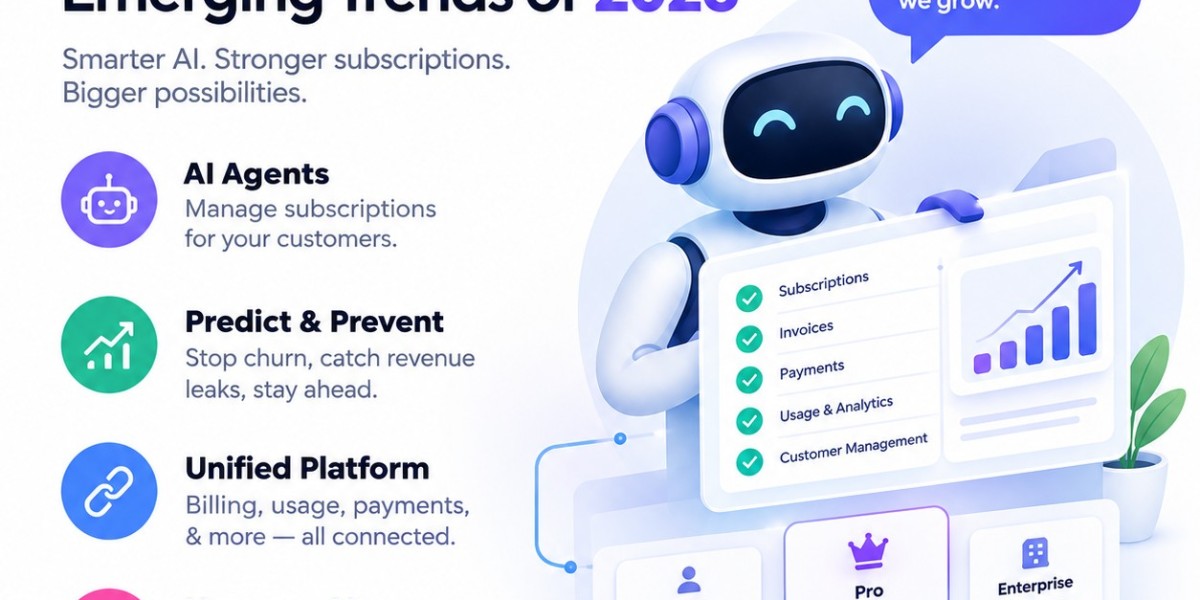

Subscriptions have become an essential part of the modern digital economy. From streaming platforms and software applications to meal kits, skincare products, and online services, consumers increasingly prefer recurring payments over one-time purchases. This shift has fueled the growth of the subscription economy, with businesses adopting flexible pricing models and recurring revenue strategies to improve customer relationships and long-term profitability. According to Zuora’s Subscription Economy Index, subscription-based businesses have demonstrated strong growth compared with traditional companies. However, managing increasing subscriber numbers, multiple pricing plans, payment methods, and complex billing structures presents new challenges. This is where AI in subscription management is becoming increasingly important, helping businesses automate billing, predict customer churn, recover failed payments, analyze contracts, and deliver personalized customer experiences.
Enterprise AI Adoption Is Transforming Subscription Businesses
In 2026, businesses are moving beyond isolated AI experiments toward enterprise-wide implementation. Instead of relying entirely on fixed billing rules, manual reconciliation, and generic payment reminders, companies are adopting AI-powered subscription management software to automate recurring workflows and make data-driven decisions. The industry is increasingly focused on integrating quoting, pricing, billing, payments, and revenue recognition into a connected process. Platforms such as SubscriptionFlow help businesses streamline subscription operations through automated billing workflows, payment recovery, churn prediction, and usage-based billing capabilities. At the same time, human-supervised AI automation is emerging as a practical approach, allowing intelligent systems to manage routine activities while finance teams retain control over sensitive financial decisions and exceptions.
AI Agents Are Changing Subscription Management
One of the most significant developments in AI-driven subscription management is the emergence of AI agents that can research products, compare plans, and perform authorized transactions on behalf of customers. Rather than navigating multiple websites manually, customers may increasingly rely on AI assistants to discover services, evaluate subscription options, and manage recurring purchases. This creates an opportunity for subscription platforms to become the transaction infrastructure behind AI-powered commerce. Businesses need systems that allow authorized agents to access structured pricing information, compare subscription plans, initiate purchases, manage upgrades and downgrades, process cancellations, and handle recurring payments. With the right permissions and safeguards, AI agents can simplify the entire subscription lifecycle while preserving merchant control, customer consent, and billing accuracy.
AI-Powered Revenue Assurance Reduces Revenue Leakage
Revenue leakage is a persistent challenge for subscription businesses. Incorrect discounts, unbilled usage, outdated contract terms, and billing errors can lead to lost revenue and unnecessary financial adjustments. Traditionally, finance teams identify these problems during month-end reconciliation, when correcting them can be time-consuming. In 2026, AI-powered revenue assurance is enabling businesses to monitor billing events continuously and identify discrepancies earlier. Intelligent systems can compare contracts, usage records, invoices, and payment data to detect missing charges or inconsistent billing terms. AI can also extract important information from contracts and convert it into structured billing workflows. By automating these checks, businesses can improve billing accuracy, reduce manual workloads, and establish stronger financial controls across complex subscription models.
Usage-Based and Outcome-Based Pricing Are Gaining Momentum
The growth of AI products is changing how software companies charge customers. Traditional seat-based pricing may not accurately reflect the value generated by autonomous AI systems, which can complete substantial amounts of work without requiring additional human users. Consequently, businesses are exploring usage-based pricing, credit-based billing, action-based pricing, and outcome-based pricing models. These approaches allow companies to charge according to measurable consumption or delivered results. For example, subscription software may bill customers based on API calls, AI-generated outputs, completed tasks, or prepaid usage credits. SubscriptionFlow supports usage-oriented billing capabilities that help businesses manage consumption-based charging and complex recurring revenue models. However, these pricing structures also increase billing complexity, making transparent usage tracking, accurate metering, and understandable invoices essential for customer trust.
AI Improves Invoice Transparency and Billing Accuracy
As subscription pricing becomes more complex, customers need clear explanations of their invoices. Charges based on thousands of API calls, variable usage rates, and credit deductions can be difficult to understand without additional information. AI-powered billing analytics can help explain invoice line items in plain language, identify unusual consumption patterns, and notify customers when they approach usage limits. Businesses can also use AI to detect duplicate events, flag unexpected charges, and identify potential invoicing errors before invoices are issued. These capabilities improve invoice transparency, reduce billing disputes, and help finance teams resolve exceptions more efficiently. When combined with reliable usage data and appropriate human oversight, AI can make even complex subscription pricing models easier to manage.
Predictive Billing Simulations Support Better Financial Decisions
Another emerging trend is the use of AI-powered billing simulations to evaluate the financial impact of subscription changes before they are implemented. Contract amendments, pricing adjustments, discounts, and allocation changes can affect invoices, revenue schedules, and accounting records. Without proper validation, these changes may create errors that require credit notes or additional reconciliation. Intelligent billing systems can compare existing contract terms with proposed changes, identify affected invoice items, and estimate their financial impact. Finance teams can review these simulations and approve significant changes before they reach production. This approach supports proactive revenue management, reduces avoidable billing errors, and helps businesses maintain more consistent financial records.
AI-Driven Retention Must Follow Cancellation Regulations
Customer retention remains a major priority for recurring revenue businesses, and AI-powered churn prediction can help identify subscribers who may be considering cancellation. By analyzing factors such as declining product usage, failed payments, customer feedback, and engagement patterns, AI systems can identify opportunities for timely intervention. Businesses can then offer relevant solutions, including plan adjustments, subscription pauses, or personalized incentives where appropriate. However, retention strategies must not create unnecessary obstacles for customers who want to cancel. Subscription businesses need to consider applicable automatic renewal laws, consumer protection requirements, cancellation disclosures, and jurisdiction-specific rules. A responsible approach separates retention recommendations from cancellation execution, ensuring that customers can cancel clearly and promptly while businesses use AI to improve customer satisfaction and reduce avoidable churn.
AI Supports Revenue Recognition and Audit Readiness
As businesses adopt usage-based and outcome-based pricing, revenue recognition becomes increasingly important. Recognizing revenue correctly depends on the contract terms, the nature of the promised service, and the applicable accounting standards. AI can assist finance teams by extracting contract information, organizing billing data, identifying unusual accounting entries, and comparing transactions against established policies. It can also help maintain detailed records of automated actions, approvals, and changes. These AI-powered audit trails make it easier for finance teams to investigate discrepancies and demonstrate how important decisions were made. Nevertheless, AI-generated accounting recommendations should be reviewed against applicable accounting requirements, including ASC 606 where relevant, with qualified professionals overseeing material judgments and final reporting.
Proactive AI Agents Improve the Customer Lifecycle
Traditional customer support automation often focuses on answering frequently asked questions. Modern AI customer lifecycle management goes further by identifying problems and taking authorized steps to resolve them. For example, an AI agent may detect a failed subscription renewal, identify the likely payment issue, guide the customer through updating payment details, and notify the support team if additional assistance is required. Other applications include identifying declining engagement, recommending suitable subscription plans, explaining billing changes, and providing timely renewal reminders. By addressing problems before they escalate, proactive AI automation can improve customer experiences, reduce support workloads, and support long-term retention. The most effective systems combine account-level insights with clear permissions, transparent communication, and human escalation for complex situations.
How to Implement AI in Your Subscription Business
Businesses looking to adopt AI subscription management solutions should begin with measurable operational challenges rather than implementing AI simply to follow a trend. Payment recovery, billing disputes, invoice exceptions, and customer churn are practical starting points because their performance can be tracked through clear metrics. Companies should also ensure that contract information, customer records, usage events, and billing data are accurate and accessible. Establishing AI governance is equally important: businesses must define which actions AI can execute independently, which require human approval, and which should remain restricted. Finally, teams should measure business outcomes such as recovered revenue, reduced billing errors, lower support costs, and improved retention rather than focusing only on the number of automated tasks.
The Future of AI in Subscription Management
The future of AI in subscription management will be shaped by intelligent automation, flexible pricing models, AI agents, and increasingly connected financial workflows. Businesses will continue exploring ways to reduce revenue leakage, simplify complex billing operations, personalize customer experiences, and improve financial visibility. However, successful implementation requires more than advanced algorithms. Reliable data, transparent pricing, secure integrations, regulatory compliance, and meaningful human oversight remain essential. Platforms such as SubscriptionFlow can help subscription businesses manage recurring billing, usage-based pricing, payment recovery, and lifecycle workflows within a more connected operational environment. Ultimately, the companies that gain the greatest value from AI will be those that combine automation with accountability and use technology to build more efficient, transparent, and customer-focused subscription experiences.