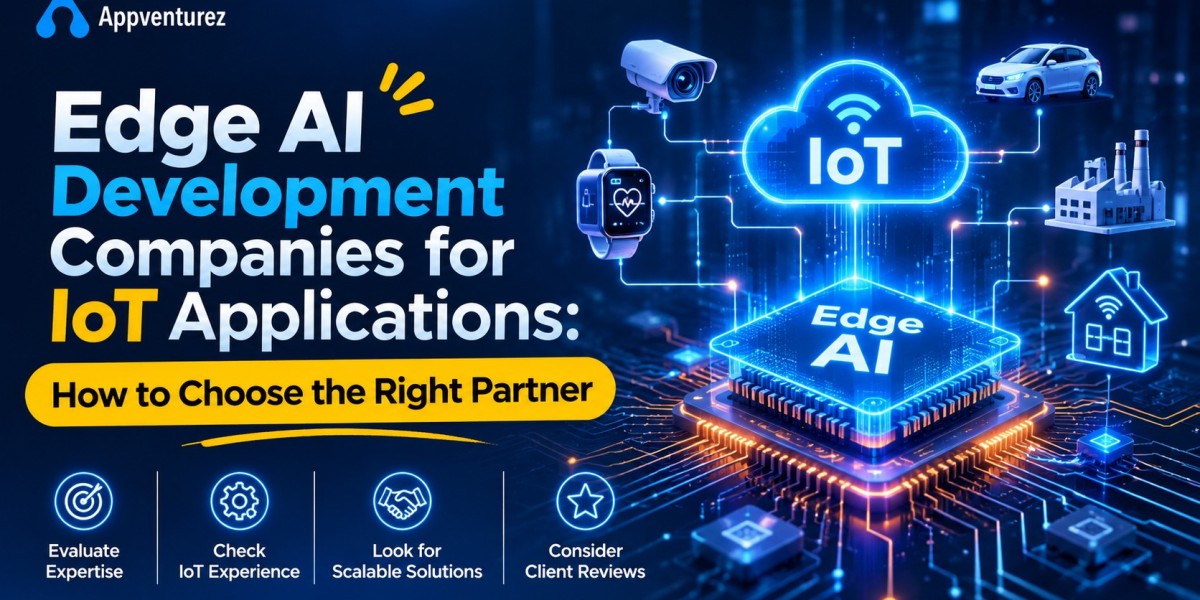

For years, the standard recipe for smart devices was simple: sensors collect data, the data travels to the cloud, a model running in a data center makes a decision, and the answer travels back. It works, until it doesn't. A camera on a remote farm has no reliable connection. A factory robot cannot wait half a second for a round trip. A hearing aid or a smartwatch has a battery the size of a coin. A hospital does not want patient video leaving the building. And a fleet of a million devices streaming raw data to the cloud can generate a bill that erases the business case.
Edge AI solves these problems by running machine learning directly on the device or on a nearby gateway. Instead of sending everything to the cloud, the device interprets sound, images, vibration, and motion locally, and sends only what matters: an alert, a summary, an exception. The benefits are compelling: faster responses, lower bandwidth and cloud costs, operation without connectivity, and better privacy because raw data can stay where it was captured.
But edge AI is also genuinely hard. It sits at the intersection of machine learning, embedded systems, hardware design, power management, connectivity, security, and fleet operations. A team that excels at cloud ML may struggle to fit a model into a few hundred kilobytes of memory, and a firmware team that excels at microcontrollers may not know how to train, validate, and monitor a model. That is why choosing the right edge AI development company matters so much.
This guide helps you choose well. Rather than publishing a ranking that would rest on unverifiable claims and age quickly, it explains what edge AI is, where it fits, what the best development partners do, the capabilities to look for, the questions to ask, the red flags to avoid, and how to structure an engagement. Companies like Appventurez build intelligent solutions across mobile, IoT, cloud, wearable, and enterprise platforms, and the criteria below apply to any provider you consider, including them.
Note: Hardware, frameworks, and pricing change quickly. Tools named here are widely used examples, not endorsements or an exhaustive list. Verify every provider's claims with references, live demonstrations on real hardware, and written proposals before you commit.
What is Edge AI?
Edge AI means running AI models, usually machine learning inference, close to where data is generated rather than in a centralized cloud. "The edge" is a spectrum.
The Edge Spectrum
Tiny edge (TinyML): Microcontrollers with kilobytes to a few megabytes of memory, running on milliwatts. Examples: keyword spotting, vibration anomaly detection, simple gesture recognition
Device edge: Smartphones, wearables, cameras, appliances, and embedded Linux boards with more memory and sometimes dedicated neural accelerators
Gateway and near edge: Industrial gateways, on-premises servers, and edge boxes that aggregate data from many devices and run heavier models
Cloud: Large-scale training, fleet analytics, and heavy inference, often working together with the edge
Most real systems are hybrid. Training happens in the cloud, compact models run at the edge, and data flows between them for monitoring and improvement.
Edge AI vs. Cloud AI
Latency: Edge decisions happen in milliseconds with no network round trip
Bandwidth and cost: Sending only insights, not raw streams, reduces data transfer and cloud spend
Reliability: Edge devices keep working when connectivity is poor or absent
Privacy: Sensitive audio, video, and health data can stay on the device
Power: Local inference can use less energy than transmitting data, though models must be efficient
Limits: Edge devices have constrained memory, compute, and battery, so models must be small and optimized
Where Edge AI Delivers Value in IoT
A strong partner will have relevant production experience in the areas that matter to you.
Industrial and Manufacturing IoT
Predictive maintenance: Detecting abnormal vibration, temperature, or current patterns on the machine itself
Visual quality inspection: Spotting defects on the line in real time
Worker safety: Detecting missing protective equipment or hazardous proximity
Process monitoring and anomaly detection
Smart Buildings and Homes
Occupancy and presence sensing, with privacy protection
Voice commands and wake-word detection processed locally
Energy optimization and fault detection in HVAC systems
Security cameras with on-device person and package detection
Wearables and Healthcare Devices
Activity recognition and sleep analysis on smartwatches and bands
Anomaly detection in heart rate and other signals, subject to regulatory considerations
Fall detection for older adults
Hearing and audio processing
Automotive and Mobility
Driver monitoring and in-cabin sensing
Predictive maintenance for vehicles and fleets
Edge analytics on telematics devices
Retail and Logistics
Shelf and inventory monitoring with cameras
Footfall and queue analytics
Cold-chain monitoring with local anomaly detection
Asset tracking with smart sensors
Agriculture and Environment
Crop and livestock monitoring in areas with little connectivity
Pest and disease detection from images
Wildlife, water, and air-quality sensing
Energy and Utilities
Smart meter analytics, including tamper and theft detection
Grid and equipment fault detection
Renewable generation monitoring
Why Edge AI Is a Specialized Discipline
Several things make edge AI different from standard ML development.
Hard Resource Constraints
A microcontroller may offer a few hundred kilobytes of memory and no floating-point hardware. Every kilobyte and every milliwatt counts.
Hardware Diversity
Microcontrollers, application processors, GPUs, NPUs, and specialized accelerators each have different toolchains, supported operations, and performance characteristics. A model that runs well on one chip may not run at all on another.
Real-World Data
Sensors drift, environments vary, and devices differ from unit to unit. Data collected in the lab rarely matches the field.
Power and Thermal Limits
Battery life and heat are design constraints, not afterthoughts.
Connectivity Is Unreliable
Devices must work offline, sync when they can, and handle interruptions gracefully.
Fleet-Scale Operations
Updating models on thousands or millions of deployed devices, safely and with rollback, is a major engineering challenge.
Security Exposure
Devices sit in the field, physically accessible to attackers. Firmware, models, and keys all need protection.
The Edge AI Development Lifecycle
A strong partner follows a disciplined path that spans hardware, firmware, ML, and cloud.
Step 1: Define the Use Case and Constraints
Clarify the decision to be made, accuracy needs, latency, power budget, cost per unit, connectivity, privacy, and regulatory requirements.
Step 2: Select Hardware and Architecture
Choose the chip, sensors, memory, connectivity, and the split between device, gateway, and cloud. Hardware choices made early constrain everything later.
Step 3: Collect and Prepare Data
Gather representative data from the actual sensors in realistic conditions, with accurate labels, and build tools to keep collecting from the field.
Step 4: Build and Train Models
Start with a simple baseline, then develop models sized for the target hardware. Often this means classic ML or compact neural networks rather than large models.
Step 5: Optimize for the Edge
Compress and accelerate the model using quantization, pruning, distillation, architecture choices, and operator-aware design, then verify that accuracy holds.
Step 6: Deploy and Integrate Firmware
Convert the model to a runtime format, integrate it into firmware or an embedded application, and optimize memory, scheduling, and power use.
Step 7: Test on Real Hardware
Measure accuracy, latency, memory, and energy on the actual target device, in realistic conditions, over long periods. Emulators are not enough.
Step 8: Secure the Device and Model
Implement secure boot, signed updates, encrypted storage and communication, and device identity.
Step 9: Roll Out and Update Over the Air
Deploy in stages, monitor health, and update models and firmware remotely with rollback protection.
Step 10: Monitor the Fleet and Improve
Track performance, drift, and device health, collect hard examples, retrain, and redeploy.
Technologies Edge AI Partners Should Know
Tool names change, but a capable partner should be comfortable across these categories.
Model Frameworks and Runtimes
TensorFlow Lite and TensorFlow Lite for Microcontrollers, ONNX Runtime, PyTorch-based mobile and edge runtimes such as ExecuTorch, and Apache TVM
Vendor runtimes and toolkits such as NVIDIA TensorRT, Intel OpenVINO, and chip-specific SDKs from microcontroller and NPU vendors
Mobile frameworks such as Core ML on Apple devices and Android's on-device ML capabilities
Edge ML Platforms and Tooling
TinyML and edge-focused development platforms that help collect data, train, and deploy models to microcontrollers
Model conversion and benchmarking tools to test performance on target hardware
Hardware Platforms
Microcontrollers, such as Arm Cortex-M based chips, with optional DSP or neural acceleration
Single-board computers and modules, including embedded Linux boards and NVIDIA Jetson-class devices
Dedicated accelerators and NPUs from various vendors
Mobile and wearable system-on-chips
Industrial gateways and edge servers
Operating Systems and Firmware
RTOS options such as FreeRTOS and Zephyr, embedded Linux, Android, and bare-metal firmware
C and C++ expertise, plus Rust and Python where appropriate
Connectivity and Messaging
Bluetooth Low Energy, Wi-Fi, cellular, LoRaWAN, Zigbee, Thread, and others
MQTT, CoAP, and HTTPS for communication with gateways and the cloud
Cloud and Fleet Management
Cloud IoT and edge services from AWS, Microsoft Azure, and other platforms, or self-managed alternatives
Device provisioning, OTA update, and monitoring tools
MLOps pipelines for training, validation, packaging, and deployment
Optimization Techniques
Quantization (for example, converting weights and activations to lower precision)
Pruning and sparsity
Knowledge distillation
Neural architecture search and efficient architectures
Feature extraction in signal processing to reduce what the model must learn
Key Criteria for Evaluating Edge AI Development Companies
1. Genuine Edge and Embedded Experience
What to look for:
Shipped products running models on real devices, not only cloud demos
Experience with your class of hardware, whether microcontrollers, embedded Linux, mobile, or industrial gateways
Case studies describing constraints, trade-offs, and measured results, such as memory, latency, accuracy, and battery life
References from clients you can speak with
Be careful of: Firms that rebrand cloud ML as "edge AI" without hardware-level work.
2. Full-Stack Capability
Edge AI projects fail at the seams between disciplines. The best partners can handle the whole chain.
What to look for:
Data science and ML engineering
Embedded firmware and hardware integration
Connectivity and protocol expertise
Cloud backend and device management
Mobile and web applications for configuration and dashboards
QA and field testing
3. Model Optimization Skill
What to look for:
Hands-on experience with quantization, pruning, and distillation, and with verifying accuracy afterward
Ability to profile models on target hardware and make informed architecture trade-offs
Willingness to choose simpler models and signal-processing features when they work better at the edge
Benchmarks on real devices, not just on development machines
4. Hardware Awareness and Selection Advice
What to look for:
Independent, vendor-neutral guidance on chip and sensor selection, based on your requirements
Understanding of memory, compute, power, cost, and supply considerations
Experience working with hardware vendors' toolchains and with custom boards
Honest advice when your target hardware is too constrained for the task
5. Data Strategy for the Field
What to look for:
Methods for collecting representative sensor data, including edge cases and failure modes
Labeling approaches and quality control
Handling of sensor variation, drift, and noise
Pipelines to gather and curate hard examples from deployed devices, within privacy rules
Synthetic data and augmentation, used carefully
6. Power and Performance Engineering
What to look for:
Experience measuring energy per inference and optimizing duty cycles
Techniques such as wake-on-event sensing and cascaded models, where a tiny model triggers a larger one
Real battery-life testing under field conditions
7. Security and Privacy
What to look for:
Secure boot, signed firmware and model updates, and rollback protection
Unique device identity and protected key storage
Encrypted communication and storage
Model protection against extraction or tampering where it matters
Privacy-by-design, such as on-device processing and data minimization
Familiarity with relevant standards and regulations for your products and markets
8. OTA Updates and Fleet Operations
What to look for:
Experience with staged rollouts, health monitoring, and automatic rollback
Strategies for updating models separately from firmware
Handling of mixed hardware and software versions across a fleet
Monitoring for drift and degradation across devices
Awareness of connection storms and update load on servers
9. Testing and Validation Rigor
What to look for:
Evaluation on held-out, realistic data with metrics tied to the use case
Hardware-in-the-loop and long-duration testing
Environmental testing, such as temperature, noise, lighting, and vibration, where relevant
Performance reported per device variant and per condition
Field pilots before mass deployment
10. Integration and Product Engineering
What to look for:
Ability to build companion apps, dashboards, and cloud integrations
Experience with Android, iOS, wearable, and web platforms
Clear, usable interfaces for configuration, alerts, and diagnostics
Integration with enterprise systems such as ERP, CMMS, and CRM
11. Compliance and Certification Awareness
What to look for:
Understanding that connected products may need regulatory approvals such as radio and safety certifications, and, for health-related functions, medical-device considerations
Experience supporting documentation and testing, while recognizing where you need specialist certification partners
Awareness of emerging requirements for connected-device security and AI
12. Team Quality and Continuity
What to look for:
A balanced team including ML engineers, embedded engineers, hardware specialists, backend and mobile developers, QA, security specialists, and a project manager
Senior people genuinely involved in delivery
Stable teams with low turnover and clear continuity plans
13. Process and Communication
What to look for:
Agile delivery with regular demos on real hardware
A discovery and proof-of-concept phase before large commitments
Clear reporting of results in terms of accuracy, latency, power, and cost per unit
Time zone overlap or a clear communication plan
14. Transparent Pricing and Contracts
What to look for:
Detailed estimates by phase, including data collection, hardware prototyping, optimization, field testing, and security work
Clarity on exclusions, such as hardware costs, certifications, cloud fees, and third-party licenses
Realistic ongoing costs for fleet management, monitoring, and updates
Clear ownership of code, models, firmware, and data
Exit provisions and knowledge transfer
15. References and Reputation
What to look for:
Verified client references and independent reviews
Published case studies with measurable outcomes
Long-term relationships and repeat business
Certifications and partnerships, treated as supporting evidence rather than proof
Questions to Ask Every Candidate
About Experience
Which edge AI products have you shipped on real hardware, and can I speak with those clients?
Have you worked with our target chip family and sensors?
What was your hardest edge project, and what went wrong?
About Hardware and Architecture
How would you choose hardware for our requirements, and are you vendor-neutral?
What should run on the device, the gateway, and the cloud, and why?
How will you handle our power, memory, and cost-per-unit constraints?
About Models and Data
What baseline will you build first?
How do you optimize models, and how do you verify accuracy afterward?
How will you collect representative data, and what happens when the field differs from the lab?
About Security and Operations
How do you secure firmware, models, and device identity?
How will OTA updates work, and how do you roll back safely?
How will you monitor drift and performance across the fleet?
About Testing
Will you benchmark on real target hardware, and over what duration?
How will you test across temperature, noise, lighting, and device variation?
Will there be a field pilot before full deployment?
About Team and Commercials
Who will work on our project, and what are their roles and experience?
What is included in your estimate, and what is excluded?
Who owns the models, firmware, code, and data?
What are the payment terms and exit conditions?
Listen for specifics and honesty. Strong partners are comfortable saying "that chip is too small for this model," "you will need field data before we can promise accuracy," or "a simpler approach will work better here."
Red Flags to Watch Out For
Guaranteed accuracy before seeing your sensors and data
Demos that run only on a laptop or in the cloud, with no on-device benchmarks
No embedded engineers on the team
No questions about power, memory, or unit cost
Vendor lock-in disguised as advice, such as recommending hardware because of a reseller relationship
Ignoring security, OTA updates, or fleet operations
No plan for data collection from the field or for drift
Testing only in the lab
Vague answers about certifications and compliance
Unclear team structure, or a bait-and-switch between senior pitch team and junior delivery team
Ambiguous ownership of models, firmware, and data
Pressure to skip a proof of concept or sign quickly
Unusually low quotes that may omit hardware work, field testing, or support
Overpromising generative AI on constrained devices without explaining the limits
Engagement Models
Discovery and Feasibility Assessment
A short, fixed-scope phase to review requirements, hardware options, data, and architecture, and to estimate what is achievable. It is an effective way to reduce risk and test a partner.
Proof of Concept on Real Hardware
A limited project that demonstrates the model running on the target device and measures accuracy, latency, memory, and power. This is the most important de-risking step in edge AI.
Phased Development
Stages such as discovery, proof of concept, prototype, field pilot, production, and scale-up, with decision points after each. This is usually the most sensible structure for edge AI.
Fixed-Price Projects
Suitable for well-defined deliverables such as a companion app, a cloud integration, or an optimization of an existing model.
Time and Materials or Dedicated Team
Suitable for evolving products and long-term platforms. Companies that want to hire embedded and ML engineers often choose dedicated teams that work as an extension of their own.
Managed Services and Retainers
Ongoing fleet monitoring, model updates, and support under a service agreement.
Understanding Costs
Costs vary enormously, so request detailed, written estimates. These factors drive edge AI cost.
Use case complexity and accuracy requirements
Hardware constraints: Tighter limits require more optimization effort
Custom hardware work, if the project includes board design
Data collection and labeling, especially from real sensors in the field
Model development and optimization
Firmware and embedded integration
Connectivity and cloud backend
Mobile and web applications
Security work: Secure boot, signed updates, and device identity
Testing and field pilots: Hardware-in-the-loop, environmental, and long-duration testing
Certifications and compliance activities
Fleet operations: OTA infrastructure, monitoring, and support
Team size, seniority, and location
Remember that hardware cost per unit, cloud and connectivity cost per device, and maintenance over the product's life often matter as much as development cost. Compare proposals on total scope and lifetime cost, not price alone.
A Smart Selection Process
Step 1: Define the Use Case and Constraints
Capture the decision to make, accuracy and latency targets, power budget, unit cost, connectivity, privacy, and environment.
Step 2: Document Your Hardware Situation
Note whether hardware is fixed, selectable, or custom, and which sensors and interfaces are involved.
Step 3: Build a Shortlist
Collect three to five candidates from referrals, independent reviews, and IoT and embedded communities. Prioritize relevant hardware experience over marketing.
Step 4: Review Case Studies and Speak With References
Focus on projects similar to yours in hardware class, constraints, and industry.
Step 5: Hold Technical Discovery Calls
Include your embedded and ML engineers, and observe whether the candidate engages with constraints and trade-offs.
Step 6: Request Written Proposals
Compare approach, validation plan, security measures, team, timeline, assumptions, and cost breakdown.
Step 7: Run a Paid Proof of Concept on Target Hardware
Test collaboration and technical claims at limited risk, with measurements you can verify.
Step 8: Review Security and Operations Plans
Have your security team review update, identity, and monitoring designs.
Step 9: Negotiate the Contract Carefully
Check scope, milestones, intellectual property, support terms, and exit conditions.
Step 10: Set Up Governance and Review Results
Establish regular reviews on real hardware, shared dashboards, and a clear process for adjusting the design as field data arrives.
Partner Evaluation Scorecard
Rate each candidate from one to five, and weight the items that matter most to you.
Shipped edge and embedded experience
Full-stack capability across ML, firmware, cloud, and apps
Model optimization skill
Hardware awareness and vendor-neutral advice
Field data strategy
Power and performance engineering
Security and privacy practices
OTA updates and fleet operations
Testing and validation rigor
Integration and product engineering
Compliance awareness
Team seniority and stability
Process, communication, and cultural fit
Pricing transparency and contract terms
Independent reputation
Why Many Companies Consider India for Edge AI and IoT Development
India has become a global hub for AI, embedded, and software development, with a strong base of engineers across electronics, firmware, ML, and cloud.
Skilled Engineering Talent
India produces thousands of engineers every year with expertise in embedded systems, machine learning, data engineering, cloud platforms, and mobile development.
Cost-Effective Development
Compared to North America and Europe, businesses can significantly reduce development costs while maintaining high-quality standards.
Strong Technology Ecosystem
India hosts thousands of technology companies offering IoT consulting, embedded engineering, AI development, and cloud services.
Flexible Engagement Models
Businesses can choose from:
Dedicated development teams
Fixed-price projects
Hourly hiring
Staff augmentation
Offshore development centers
Global Project Experience
Indian companies work with clients across the US, UK, Europe, Australia, and the Middle East, making them familiar with international compliance expectations and agile project management.
Things to Manage in Offshore Edge Projects
Hardware logistics, access to test devices, and lab equipment need planning, since edge AI depends on testing on real devices. Agree on how prototypes will be shipped, how test results will be shared, and how security of firmware and keys will be handled. Plan overlapping working hours and clear communication from the start.
Why Choose Appventurez for Edge AI and IoT Development?
When businesses plan to bring intelligence to connected devices, choosing the right technology partner becomes crucial. Appventurez has established itself as a trusted software development company offering innovative mobile, cloud, AI, IoT, and wearable solutions tailored to different industries.
The company focuses on delivering scalable, secure, and business-oriented applications that help organizations connect devices, monitor operations in real time, and make smarter decisions. For edge use cases, that includes on-device machine learning, predictive maintenance, NLP and voice features, and wearable and sensor intelligence, together with the mobile apps, dashboards, cloud backends, and device integrations that make connected products work end to end.
By leveraging modern frameworks, cloud technologies, AI capabilities, and agile methodologies, Appventurez aims to design every solution for long-term scalability, seamless integration, strong security, and measurable outcomes. As with any provider, evaluate them against the criteria in this guide: ask for relevant case studies on real hardware, review their security and OTA practices, speak with references, and begin with a focused proof of concept.
Common Mistakes When Hiring an Edge AI Partner
Choosing on price or brand alone
Picking hardware before understanding the model's needs
Skipping a proof of concept on real hardware
Training only on clean lab data
Ignoring power, memory, and unit-cost constraints
Treating security and OTA updates as later concerns
Forgetting fleet monitoring and drift
Underestimating firmware and integration effort
Leaving ownership of models, firmware, and data unclear
Neglecting certifications and compliance until late
Future Trends in Edge AI
The field moves quickly, and these trends are worth watching.
Key trends include:
More capable neural accelerators built into low-cost microcontrollers and system-on-chips
Smaller, more efficient models, including compact language and vision models running on devices
Generative AI features moving toward the edge for privacy and latency, within tight hardware limits
Cascaded and event-driven designs that keep devices asleep until something interesting happens
Federated and on-device learning that improves models without centralizing raw data
Standardized tooling and runtimes that reduce hardware lock-in
Stronger security expectations and regulation for connected devices
Edge and cloud working as a continuum, with models moving between them as conditions change
Better fleet management, monitoring, and automated retraining pipelines
Sustainability focus, with energy-efficient AI reducing power and e-waste
Choose a partner who stays current without compromising reliability.
Frequently Asked Questions
What makes an edge AI company "top"?
Not size or marketing, but shipped products on real hardware, full-stack capability, optimization skill, vendor-neutral advice, strong security and fleet operations, rigorous field testing, and reliable long-term support.
Is edge AI always better than cloud AI?
No. Edge AI suits low latency, offline use, privacy, and bandwidth savings. Cloud AI suits heavy models and centralized analytics. Many systems combine both.
Can large language models run on edge devices?
Small language models can run on capable edge hardware such as phones and some embedded boards, within limits. Very constrained devices typically use much smaller task-specific models.
How long does an edge AI project take?
A feasibility study or proof of concept can take weeks to a few months. Prototype, field pilot, and production phases extend the timeline, especially with custom hardware and certifications.
How do you update models on deployed devices?
Through secure over-the-air updates with signed packages, staged rollouts, health monitoring, and rollback, often separating model updates from firmware updates.
Do I need custom hardware?
Not always. Many projects start with off-the-shelf modules and move to custom hardware only when volumes and requirements justify it.
Where should we start?
Pick one well-defined use case, document your constraints, and run a proof of concept on target hardware with a carefully vetted partner.
Conclusion
Edge AI brings intelligence to the place where data is born, giving IoT products faster responses, lower costs, offline resilience, and better privacy. It is also one of the most demanding forms of ML development, because success depends on getting hardware, firmware, data, models, security, connectivity, and fleet operations right together. The best edge AI development companies