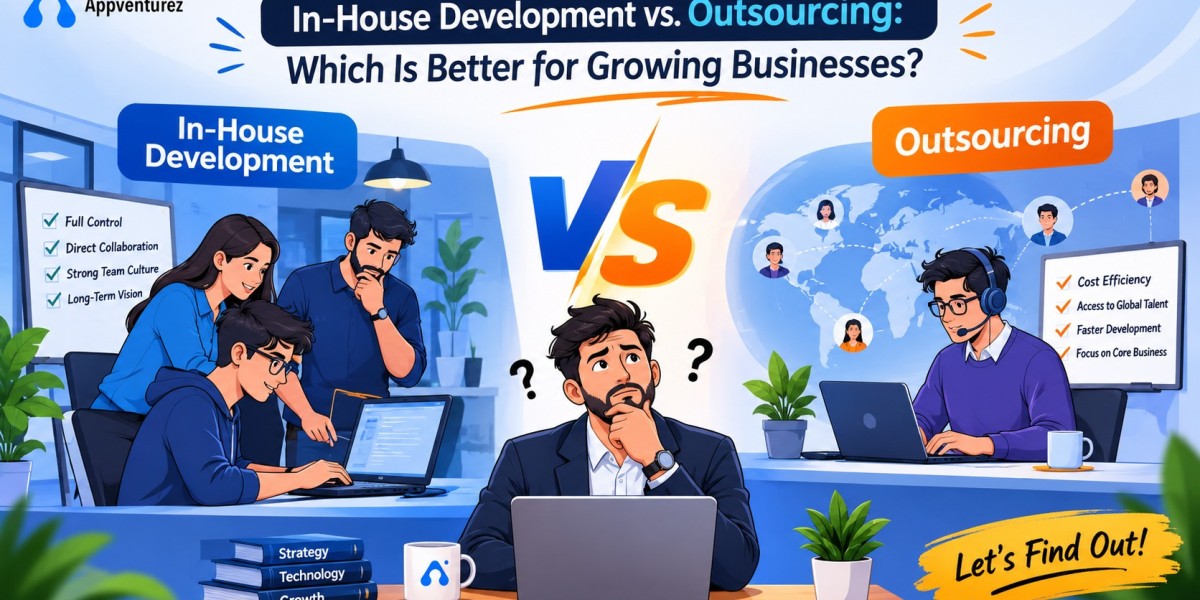

Sooner or later, every growing business faces the same question. The product is gaining traction, the backlog is growing faster than the team, and someone says: "Should we hire developers, or should we bring in an outside team?"
It sounds like a simple cost comparison, but it rarely is. Hiring in-house gives you control, culture, and deep product knowledge, but it also brings slow recruiting, rising salaries, management overhead, and long-term commitments. Outsourcing gives you speed, flexibility, and access to specialists, but it also raises questions about communication, quality, security, and dependence on someone else's team.
The honest answer to "which is better?" is that it depends on your stage, your product, your budget, and the kind of work involved. Many of the most successful growing companies do not choose one or the other. They combine both, keeping core strategic work in-house and using partners for capacity, specialized skills, and speed.
This guide helps you make that decision clearly. It compares in-house development, outsourcing, and hybrid models across cost, speed, quality, control, risk, and scalability, explains when each makes sense, and shows how to get the best from whichever you choose. The examples draw on mobile and Android development, because the mobile app is where many growing businesses first face this choice. Companies like Appventurez work with businesses as outsourced teams, dedicated teams, and extensions of in-house teams, and the principles below apply to any provider you consider.
Note: Costs, availability, and outcomes vary widely by market, role, and team. Use this article as a decision framework, and validate any approach with a small pilot before committing.
Defining the Options
In-House Development
You employ developers, designers, testers, and managers directly. They work for your company, report to your leaders, and are part of your culture. You control hiring, priorities, tools, and processes.
Outsourcing
You contract an external company to deliver software, wholly or in part. Models vary:
Project-based outsourcing: A vendor delivers a defined scope for an agreed price
Dedicated team: A vendor assigns a team that works exclusively on your product, usually for a monthly fee
Staff augmentation: Individual contractors join your team to fill skill gaps
Managed services: A vendor takes responsibility for ongoing development, maintenance, and operations
Hybrid Models
A mix of both: a small in-house core handling product strategy, architecture, and key decisions, working alongside an external team that provides capacity, specialized skills, or round-the-clock coverage.
Location Variants
Onshore: Partner in your own country
Nearshore: Partner in a nearby country or similar time zone
Offshore: Partner in a distant country, such as India, often with significant cost advantages
In-House Development: Strengths and Weaknesses
Strengths
Control: You set priorities, processes, and standards directly
Deep product knowledge: The team lives inside your product and customers every day
Culture and alignment: Developers share your mission, values, and context
Fast internal communication: No external coordination layer
Knowledge retention: Expertise builds inside the company
Security and confidentiality: Sensitive code and data stay under your direct governance
Long-term commitment: Employees can grow with the product
Weaknesses
Slow, competitive hiring: Finding strong engineers can take months, particularly in specialized areas such as mobile, AI, and security
High fully loaded cost: Salary is only part of it. Benefits, taxes, equipment, recruiting fees, management time, training, and office costs add substantially
Fixed capacity: It is hard to scale up quickly for a big push, or scale down when work slows
Skill gaps: One team rarely covers every skill the product needs
Retention risk: When key people leave, knowledge leaves with them
Management overhead: Engineering teams require leaders, processes, and ongoing development
Bandwidth limits: Small teams spend much of their time on maintenance and cannot take on new initiatives easily
Outsourcing: Strengths and Weaknesses
Strengths
Speed to start: A good partner can begin in weeks, not months
Access to broad skills: Mobile, backend, cloud, AI, QA, design, and DevOps can be available at once
Flexible capacity: Teams can scale up or down with demand
Cost efficiency: Especially with offshore and nearshore partners, hourly costs can be much lower, and you avoid recruiting and overhead costs
Focus: Your leaders can focus on strategy and customers rather than hiring and management
Experience: Established firms have seen many projects, and bring proven processes and tools
Reduced hiring risk: If the fit is poor, you can change course faster than with employees
Weaknesses
Less direct control: You manage through contracts, communication, and governance rather than hierarchy
Communication friction: Time zones, language, and cultural differences can slow collaboration if not managed well
Knowledge risk: Understanding of your product sits with the vendor, so documentation and continuity matter
Quality variability: Providers differ enormously, and poor choices can be costly
Security and IP concerns: Sharing code, data, and systems requires strong agreements and controls
Vendor dependence: Switching providers has a cost
Misaligned incentives: A vendor paid by the hour or the project may not share your long-term goals unless the contract and relationship are well designed
Side-by-Side Comparison
Cost
In-house: Higher fully loaded cost per person, plus recruiting and overhead. Cost is fixed, whether or not work is available
Outsourcing: Often lower per-hour cost, especially offshore, with flexible spending. Total cost depends on management effort and quality
Speed
In-house: Slow to build, fast once established for work inside the team's skills
Outsourcing: Fast to start and scale, with a ramp-up period to learn your product
Control
In-house: Highest
Outsourcing: Moderate, and depends on governance, communication, and contract design
Product Knowledge
In-house: Deep and persistent
Outsourcing: Builds over time, especially with dedicated and stable teams
Skills and Flexibility
In-house: Limited to who you have hired
Outsourcing: Broad, with specialists available when needed
Scalability
In-house: Slow to scale up or down
Outsourcing: Flexible, subject to partner capacity
Quality
In-house: Depends on hiring and management quality
Outsourcing: Depends on partner choice. The best match or exceed in-house quality, while poor choices fall short
Security and Confidentiality
In-house: Direct control
Outsourcing: Depends on agreements, controls, and the partner's practices
Management Burden
In-house: Heavy: hiring, retention, performance, career paths
Outsourcing: Lighter on people management, heavier on vendor management and coordination
Risk
In-house: Key-person dependence, hiring mistakes, fixed costs
Outsourcing: Vendor dependence, quality variance, communication gaps
A Realistic Look at Cost
Cost comparisons often go wrong because they compare a salary to an invoice. Compare fully loaded cost and delivered value instead.
The True Cost of an In-House Developer
Beyond salary, include:
Recruiting fees and the time hiring managers spend interviewing
Benefits, taxes, insurance, and paid leave
Equipment, software licenses, and workspace
Onboarding and training, during which productivity is lower
Management and administrative overhead
Downtime between projects, since salaries are paid whether or not there is work
Turnover costs: replacing an engineer can take months of lost productivity and recruiting effort
As a rough planning habit, many organizations find the fully loaded cost of an employee is meaningfully higher than base salary, though the exact multiple varies by country and company.
The True Cost of Outsourcing
Beyond the vendor's rates, include:
Vendor management time from your side
Onboarding the partner to your product and domain
Extra documentation and communication effort
Quality assurance, acceptance testing, and review on your side
Possible rework if requirements are misunderstood
Security and legal review
Transition costs if you change providers later
Comparing Fairly
Use a simple approach.
Estimate the work needed over a defined period, such as twelve months
Calculate fully loaded in-house cost for the team required to deliver it, including ramp-up time
Calculate outsourced cost, including your management and quality-assurance overhead
Compare delivered capacity, speed to start, flexibility, and risk, not just totals
For short-term, spiky, or specialized work, outsourcing is frequently cheaper. For steady, long-term, core work, in-house can be cheaper over time, though not always.
When In-House Makes More Sense
Building your own team is usually the better choice when:
The software is your core competitive advantage, and deep, continuous ownership matters
Work is steady and long-term, so capacity stays busy and fixed cost is justified
Domain knowledge is extremely specialized and slow to learn
Security or regulatory constraints make external access impractical
Rapid, informal iteration with product, design, and customers is essential
You can compete for talent, through brand, compensation, location, or mission
You have strong engineering leadership able to hire, manage, and retain a team
When Outsourcing Makes More Sense
Outsourcing is often the better choice when:
You need to move quickly, and cannot wait months to hire
You lack specific skills, such as mobile, AI, IoT, security, or cloud architecture
Work is project-based or variable, with peaks and valleys
You are validating an idea and want to limit fixed commitments
You are a startup or small business without a technical leader
Budget is constrained, and offshore or nearshore rates offer significant savings
The work is non-core, such as internal tools, maintenance, or integrations
You need coverage across time zones, for example round-the-clock support
You want to focus your team on strategy and customers, not recruiting and management
The Hybrid Model: Often the Best Answer for Growing Businesses
For many growing companies, the strongest approach combines both.
A Common Pattern
In-house core: A small team of product leaders, architects, and senior engineers who own strategy, architecture, quality standards, and key decisions
External team: A dedicated partner team that builds and maintains features, handles specialized work, and adds capacity as needed
Shared processes: Common tools, repositories, standards, sprint ceremonies, and reviews, so the external team works like an extension of the internal one
Why It Works
You keep control of what matters most: product direction, architecture, and quality
You get speed and flexibility without a large fixed headcount
Knowledge is shared, so you are not dependent on one side
You can adjust the mix as the company grows, moving work in-house when it becomes core and steady
Making Hybrid Work
Define clear roles and decision rights
Integrate the teams: same stand-ups, same backlog, same tools
Keep repositories, cloud accounts, and documentation under your ownership
Invest in documentation and onboarding
Measure outcomes, not hours
How the Decision Changes as You Grow
Early Stage: Idea and Validation
Speed and low commitment matter most. Outsourcing or a very small in-house team with outsourced support often works best. Focus on an MVP and learning.
Growth Stage: Product-Market Fit
Demand is rising, and the product needs to scale. A hybrid model is common: hire a core leadership team and key engineers, and use a partner for capacity and specialized skills.
Scaling Stage: Expanding Product and Organization
As the product becomes central and work becomes steadier, bring more strategic work in-house, while keeping partners for peaks, new platforms, and non-core systems.
Mature Stage: Optimization
Established businesses often keep a strong internal core, and use partners selectively for modernization, new initiatives, and cost-efficient maintenance.
Applying the Decision to Mobile and Android Products
Mobile development shows the trade-offs clearly.
Why Mobile Is a Common Outsourcing Use Case
Mobile talent, particularly experienced Android and iOS engineers, is in high demand and hard to hire
Many businesses need an app but not a permanent large mobile team
Apps need many skills at once: design, native development, backend, QA, and release management
Platform changes, such as new Android versions and store policies, require ongoing attention
Questions to Ask for Your App
Is the app your core product or a supporting channel?
Do you have steady, long-term mobile work, or project-based needs?
Do you have an experienced mobile lead who can set architecture and standards?
How quickly do you need to launch?
What is your budget for fixed headcount?
Choosing an Android Development Partner
If outsourcing or going hybrid makes sense, partner quality is the biggest factor in success. When comparing an Android app development company, an Android application development company, or an Android mobile app development company, look beyond the rate.
Live apps with strong ratings and regular updates
Modern Android engineering practices, including Kotlin, Jetpack Compose, automated testing, and CI/CD
Testing on real devices across versions and manufacturers
Backend, cloud, and API capability, not only the app layer
Stable teams, low turnover, and a clear continuity plan
Transparent estimates and clear ownership of code, accounts, and data
A maintenance plan after launch
References from long-term clients
Whether you are reviewing the top Android app development companies on a list or searching for the best Android app development company for your situation, treat rankings as a starting point and verify through references, live apps, and a pilot. A good Android app development agency will also tell you honestly when in-house capability would serve you better, or when a hybrid model fits.
Android App Development Services in Different Models
Professional Android app development services can be structured to fit each model.
Project-based: Discovery, design, development, testing, and launch of a defined app
Dedicated team: A stable Android team working as an extension of yours on an ongoing roadmap
Staff augmentation: Specialist Android engineers added to your in-house team
Managed services: Ongoing maintenance, monitoring, updates, and support after launch
Custom Android app development services are particularly valuable when the app is central to your business and needs deep integration with your systems, but the choice of model still depends on your capacity to lead and manage the work.
Managing Outsourcing Well
Most outsourcing failures come from management gaps, not from outsourcing itself.
Before You Start
Define goals, scope, success metrics, and constraints clearly
Shortlist partners based on relevant experience and references
Start with a paid pilot or discovery phase
Review security practices and sign appropriate confidentiality and data-protection agreements
Agree on ownership of code, designs, accounts, and data
During the Engagement
Assign a strong internal owner for the relationship, with real authority
Hold regular demos of working software, not only status reports
Use shared tools for tasks, code, and communication
Keep documentation current, so knowledge is not locked in anyone's head
Agree on overlapping working hours and response expectations
Review quality through code reviews, automated tests, and acceptance criteria
Treat the partner team as colleagues, with context and respect
Protecting Yourself
Keep repositories and cloud accounts under your ownership from day one
Require architecture documentation and decision records
Plan for knowledge transfer and exit from the start
Avoid dependence on proprietary tools that you cannot take with you
Reviewing the Relationship
Twice a year, review whether the partnership is delivering value, whether costs and quality are on track, and whether the mix of in-house and external work still fits.
Managing In-House Teams Well
Building a team has its own disciplines.
Hire for fit and capability, not just credentials, and invest in a strong interview process
Hire senior leadership first, so the team has direction and standards
Build a culture of code review, testing, documentation, and learning
Plan for retention, with growth paths, fair compensation, and meaningful work
Avoid single points of failure, through shared ownership and documentation
Use contractors or partners to cover peaks and skill gaps
Keep technical debt in check, since small teams get buried by maintenance
Red Flags in Each Approach
Warning Signs With In-House
Hiring takes so long that the roadmap stalls
One or two people hold all the critical knowledge
The team spends most of its time on maintenance with no capacity for new work
Key roles stay unfilled for months
Engineers leave faster than you can replace them
Warning Signs With Outsourcing
The partner agrees to everything and pushes back on nothing
Senior people appear in sales and disappear in delivery
Estimates keep growing without clear reasons
Documentation is thin and knowledge sits with a few individuals
You cannot easily access your own code or accounts
Quality problems keep recurring
Communication is slow, vague, or defensive
Common Mistakes in This Decision
Comparing salary to invoices instead of fully loaded cost and delivered value
Choosing on price alone
Treating the choice as permanent, when the right mix changes as you grow
Outsourcing without an internal owner to guide and review the work
Hiring too many people too early, before the product is validated
Ignoring knowledge management, on either side
Giving up control of architecture and strategy to a vendor
Skipping the pilot
Neglecting security and IP terms
Failing to plan for exit or transition
A Simple Decision Framework
Work through these questions.
1. Is This Work Core to Your Competitive Advantage?
Yes: keep strategic ownership in-house, with partners for capacity
No: outsourcing is often efficient
2. How Stable and Long-Term Is the Workload?
Steady and ongoing: in-house or dedicated team
Variable or project-based: outsourcing or augmentation
3. How Fast Do You Need to Move?
Quickly: outsourcing, or hybrid
With time to build: in-house becomes more feasible
4. Do You Have the Skills and Leadership?
Strong technical leadership: you can manage in-house or a hybrid
No technical leader: an experienced partner can provide guidance, but consider hiring a senior technical lead soon
5. What Are Your Security and Compliance Constraints?
Strict: favor in-house or a carefully vetted partner with strong controls
Moderate: well-governed outsourcing is workable
6. What Is Your Budget and Cash Position?
Constrained: outsourcing preserves flexibility
Healthy and growing: investing in a core team may pay off
7. How Hard Is It to Hire for This Role in Your Market?
Very hard: partners can fill the gap
Manageable: in-house may be practical
A Rule of Thumb
Keep strategy, architecture, and product ownership close to the business. Use partners for capacity, specialized skills, and speed. Revisit the balance every six to twelve months.
Why Many Growing Businesses Choose India for Outsourced Development
India has become one of the world's largest hubs for software and mobile development, and many growing businesses use it for outsourced and hybrid teams.
Skilled Engineering Talent
India produces thousands of engineers every year with expertise in mobile development, cloud platforms, data engineering, AI, and embedded systems.
Cost-Effective Development
Compared to North America and Europe, businesses can significantly reduce development costs while maintaining high-quality standards.
A Mature Ecosystem
India hosts thousands of technology companies, which is why many businesses search for an Android app development company in India or an Android app development agency in India when planning outsourced or hybrid mobile development.
Flexible Engagement Models
Businesses can choose from:
Dedicated development teams
Fixed-price projects
Hourly hiring
Staff augmentation
Offshore development centers
Global Project Experience
Indian companies work with clients across the US, UK, Europe, Australia, and the Middle East, making them familiar with international compliance expectations and agile project management.
Things to Manage in Offshore Partnerships
Time zone differences, communication habits, and cultural expectations need attention. Agree on overlapping working hours, regular meetings, shared tools, and clear documentation from the start, and favor partners with strong experience serving international clients.
Why Choose Appventurez as Your Development Partner?
When growing businesses decide to bring in outside expertise, choosing the right technology partner becomes crucial. Appventurez has established itself as a trusted software development company offering innovative mobile, cloud, AI, IoT, and wearable solutions tailored to different industries.
As an experienced Android app development company and provider of custom Android app development services, Appventurez focuses on delivering scalable, secure, and business-oriented applications that help organizations launch faster, extend their teams, and grow with confidence. Whether you need a complete outsourced build, a dedicated team that works as an extension of your in-house engineers, or specialist developers to fill a gap, the team combines technical expertise with a deep understanding of business needs, across Android and iOS apps, cloud platforms, AI and NLP features, and IoT integrations.
By leveraging modern frameworks, cloud technologies, AI capabilities, and agile methodologies, Appventurez aims to design every engagement for long-term scalability, seamless integration, strong security, and measurable business outcomes. As with any provider, evaluate them against the criteria in this guide: ask for relevant case studies, speak with long-standing clients, meet the people who would do the work, and begin with a focused pilot.
Future Trends in Build-vs-Outsource Decisions
The way businesses structure development teams is evolving, and these trends are worth watching.
Key trends include:
Hybrid and distributed teams becoming the default for growing companies
AI-assisted development changing how much work small teams can handle, while raising the importance of review and judgment
Dedicated-team and product-team models replacing pure project outsourcing
Greater emphasis on security, privacy, and supply-chain transparency in vendor relationships
Outcome-based and value-linked engagement models
Better collaboration tooling narrowing the gap between internal and external teams
Platform engineering reducing the infrastructure burden for small in-house teams
Growing competition for specialized talent in AI, mobile, and cloud
Businesses that stay flexible, and revisit the mix regularly, will adapt best.
Frequently Asked Questions
Is outsourcing always cheaper than in-house?
Not always. It is often cheaper for short-term, variable, or specialized work, especially offshore. For steady, long-term core work, in-house can be more economical. Compare fully loaded cost and delivered value.
Is in-house quality always better?
No. Quality depends on the people and practices, not the employment model. Strong partners often match or exceed weak in-house teams, and the reverse is also true.
Can I outsource without losing control?
Yes, with a strong internal owner, clear governance, regular demos, and ownership of code, accounts, and data from day one.
What is the best model for a startup?
Often a lean hybrid: a technical lead or very small core team, supported by an outsourced or dedicated team to build and iterate quickly while preserving cash.
When should I bring work in-house?
When it becomes core to your advantage, steady in volume, and important enough to justify a permanent team, and when you can hire and retain strong engineers.
How do I avoid vendor lock-in?
Own your repositories and accounts, require documentation, avoid proprietary tooling you cannot take with you, and agree on knowledge transfer and exit terms.
Where should I start?
Define the work, compare fully loaded costs, consider a hybrid model, and run a small paid pilot with a carefully vetted partner before committing further.
Conclusion
In-house development and outsourcing are not rivals so much as tools, and the right choice depends on what you are building, how fast you need to move, what you can afford, and how central the work is to your advantage. In-house teams offer control, culture, and deep knowledge but take time and money to build. Outsourcing offers speed, flexibility, and breadth but demands careful partner selection and active management. For most growing businesses, a hybrid approach, with a strong internal core and a trusted external team, delivers the best of both.
Whichever path you choose, protect your control of strategy and architecture, own your code and accounts, document everything, measure outcomes, and review the balance regularly as you grow. India continues to stand out as a destination for software and mobile development, offering strong engineering talent, cost-effective delivery models, and deep experience serving global clients. By partnering with an experienced development company like Appventurez, businesses can build scalable, secure, and future-ready products supported by a team that fits their stage and ambitions.
Whether you're launching your first app, scaling a platform, or deciding how to staff the next phase of growth, the right mix of in-house talent and trusted partners can help you move faster, spend wisely, and build something that lasts.