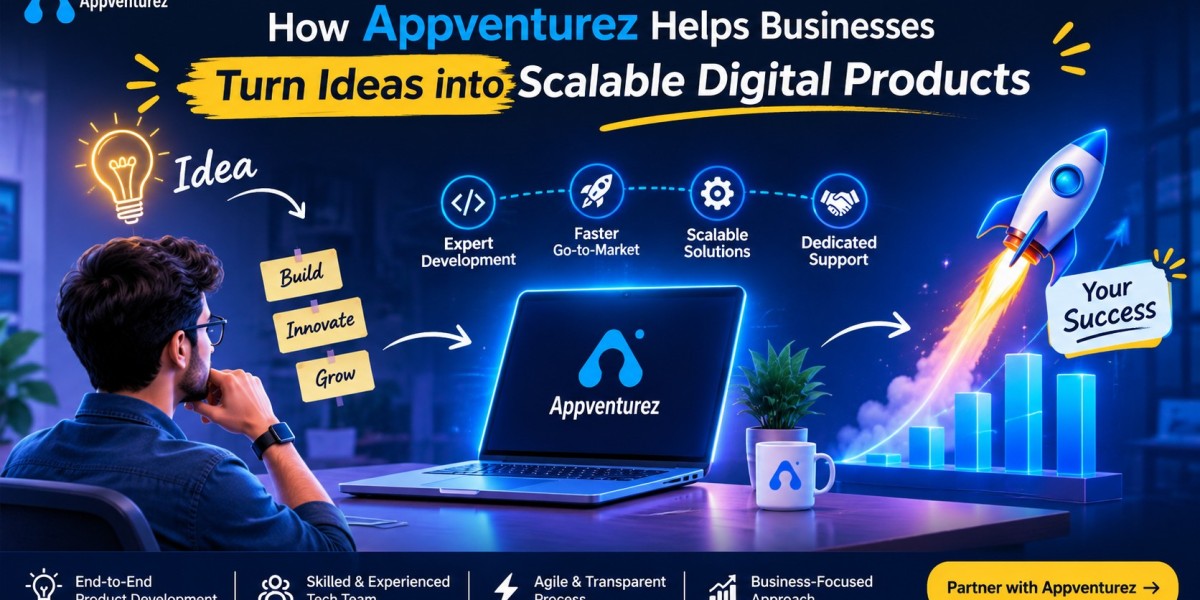

Every successful digital product begins as an idea: a better way to book appointments, a smarter way to manage inventory, a faster way to approve loans, a simpler way to learn a skill. Ideas are plentiful. What separates the few that become thriving products from the many that stall is execution: validating the right problem, designing for real users, building on an architecture that can grow, and launching with a plan to improve.
That journey is where a digital product development company earns its value. This guide explains how Appventurez helps startups, small and mid-sized businesses, and enterprises turn ideas into scalable digital products, covering its approach, services, technologies, engagement models, and the practical steps involved from first concept to long-term growth.
Note: Company figures and service details in this article should be confirmed on Appventurez’s official website before you rely on them for a purchasing decision.
The Gap Between an Idea and a Scalable Digital Product
Most product failures are not caused by bad ideas. They are caused by avoidable execution problems:
Building features nobody asked for
Skipping market and user validation
Choosing an architecture that cannot handle growth
Overspending on a first version that is too large
Underinvesting in design and usability
Ignoring security, performance, and compliance until late
Losing momentum after launch because there is no plan for iteration
A scalable digital product is one that continues to perform well as users, data, features, and integrations increase, without needing to be rebuilt from scratch. Scalability is not only about servers. It also includes the codebase, the team workflow, the data model, the user experience, and the business model.
Turning an idea into that kind of product requires a partner who combines strategy, design, engineering, and growth thinking in one process.
About Appventurez
Appventurez is a technology company that helps startups, SMEs, and enterprises build intelligent applications and AI-powered digital products.
Company snapshot
Headquarters: Noida, India
Founded: 2018
Team size: 250+ professionals
Clutch rating: 4.7/5
Minimum project size: $10,000+
Hourly rate: under $25 per hour
AI practice highlights: 100+ AI-driven products, 50+ certified AI engineers, 30+ industries, 38+ countries covered, and a 97% client satisfaction rate (as stated on the company’s AI development page)
The company provides end-to-end capabilities across AI strategy, machine learning, Generative AI, LLM applications, AI agents, computer vision, NLP, intelligent automation, and integration with existing enterprise systems through APIs, cloud platforms, and data infrastructure.
This combination of product engineering and applied AI is what allows Appventurez to support both traditional digital products and a new generation of intelligent, data-driven applications.
The Appventurez Idea-to-Product Approach
Appventurez follows a structured path that reduces risk at each stage. The steps below describe a typical journey for turning a concept into a launched, scalable product.
Step 1: Product Discovery and Idea Validation
Everything starts with understanding the problem before choosing the solution. During discovery, the team works with stakeholders to clarify:
The business goal and the problem being solved
Target users, their needs, and their current alternatives
Competitors and market positioning
Core features versus nice-to-have features
Technical feasibility and risks
Budget, timeline, and success metrics
Outputs usually include a product brief, a prioritized feature list, a rough architecture direction, and an estimate. A discovery phase prevents the most expensive mistake in software: building the wrong thing well.
Step 2: Strategy and Roadmap
With validated goals, the team defines a product roadmap that separates what must ship first from what can wait. Good roadmaps balance three things:
User value: what users need most
Business value: what drives revenue, retention, or efficiency
Technical dependencies: what must be built first to enable later features
This stage also covers monetization options, integration needs, data strategy, and, where relevant, how AI can add real value rather than novelty.
Step 3: UI/UX Design and Prototyping
Usability decides whether people adopt a product. Appventurez-style design work typically includes:
User research and personas
User journeys and information architecture
Wireframes and clickable prototypes
Visual design and design systems
Usability testing and iteration
Accessibility considerations
Prototypes let founders and stakeholders see and test the product before engineering begins, which lowers the cost of changes dramatically.
Step 4: MVP Development
A minimum viable product (MVP) is the smallest version of the product that delivers real value and produces real learning. Instead of building everything at once, the team focuses on the core user problem, launches quickly, and uses feedback to guide the next release.
Benefits of an MVP-first approach include:
Faster time to market
Lower upfront investment
Early validation with real users
Evidence for investors and internal stakeholders
A foundation that can be extended rather than discarded
The key is to build the MVP on sound architecture, so it can grow into the full product without a costly rewrite.
Step 5: Scalable Architecture and Engineering
Architecture choices made early determine how easily a product scales later. The team designs for growth through:
Modular, well-structured code
API-first design for web, mobile, and third-party integrations
Cloud-native infrastructure on AWS, Microsoft Azure, or Google Cloud
Containerization and orchestration with tools such as Kubernetes
Efficient database design and caching
Automated testing and continuous integration and delivery
Monitoring, logging, and observability
The goal is a platform that handles ten users and ten million users with planned, incremental improvements rather than emergency rebuilds.
Step 6: Integration with Existing Systems
Few products live in isolation. Appventurez supports integration with CRM, ERP, payment gateways, analytics tools, data warehouses, third-party APIs, and internal enterprise systems, so the new product fits into how the business already works.
Step 7: Quality Assurance, Security, and Compliance
Quality is built in throughout development rather than added at the end. Typical practices include:
Manual and automated functional testing
Performance and load testing
Security testing and secure coding practices
Data protection and privacy controls
Compliance alignment for regulated industries such as healthcare and fintech
Device and browser compatibility testing
Step 8: Launch and Deployment
Launch is a planned event, not a single click. The team prepares deployment pipelines, staged rollouts, app store submissions where relevant, monitoring dashboards, rollback plans, and support readiness, so the first public release is smooth and recoverable.
Step 9: Post-Launch Support and Continuous Improvement
A product is never finished at launch. After release, the focus shifts to:
Monitoring performance, stability, and costs
Fixing defects and handling support requests
Analyzing user behavior and feedback
Releasing improvements in regular iterations
Adding features from the roadmap
Optimizing infrastructure as usage grows
This feedback loop is how an MVP matures into a market-ready, scalable platform.
Digital Product Development Services
Appventurez offers a range of services that cover the full product lifecycle. Confirm the current list on the company website, but the core areas typically include:
Custom software development. Tailored web platforms, enterprise applications, internal tools, and portals built around specific business processes.
Mobile app development. Native and cross-platform apps for iOS and Android, designed for performance, usability, and growth.
Web application development. Responsive, secure, and scalable web applications, dashboards, marketplaces, and SaaS platforms.
SaaS product development. Multi-tenant architecture, subscription billing, role-based access, analytics, and integrations for software-as-a-service businesses.
UI/UX design. Research-led design, prototyping, and design systems that improve adoption and retention.
MVP and product strategy. Discovery workshops, roadmaps, rapid prototyping, and lean first releases.
Cloud and DevOps. Cloud-native architecture, migration, CI/CD pipelines, containerization, monitoring, and cost optimization.
AI and machine learning development. Custom AI, Generative AI, LLM applications, AI agents, computer vision, NLP, predictive analytics, and intelligent automation.
Quality assurance and testing. Test strategy, automation, performance, and security testing.
Maintenance and support. Ongoing updates, bug fixing, monitoring, and enhancements after launch.
AI-Powered Digital Products: Where Appventurez Adds an Intelligence Layer
A growing share of new products compete on intelligence. Users expect personalization, natural-language interfaces, automation, and smart recommendations. Appventurez combines product engineering with applied AI so these capabilities become part of the product, not an afterthought.
AI capabilities include:
Custom AI development and AI strategy
Generative AI and LLM-powered applications
AI agents for multi-step workflows
Retrieval-Augmented Generation (RAG) for knowledge-based assistants
AI chatbots and conversational AI
NLP, document intelligence, and AI-powered search
Computer vision and object detection
Predictive analytics and recommendation engines
Intelligent automation and voice AI
AI model optimization and MLOps
Example product ideas that benefit from AI
A healthcare app that summarizes patient records and supports clinicians
A fintech platform that flags suspicious transactions in real time
An e-commerce store with personalized recommendations and a shopping assistant
A logistics dashboard that forecasts delays and optimizes routes
A SaaS tool with an embedded AI assistant that answers customer questions from company documents
The approach is practical: start with a clear business problem, confirm that AI is the right tool, prototype quickly, and measure results before scaling.
Technologies and Tools
Choosing the right stack depends on the product, but the technologies Appventurez works with include:
AI and data: Python, TensorFlow, PyTorch, Scikit-learn, XGBoost, OpenAI, Claude, LLaMA, Hugging Face, LangChain, LlamaIndex, AutoGen, CrewAI, OpenCV, YOLO
Cloud and infrastructure: AWS, Microsoft Azure, Google Cloud, Kubernetes
MLOps: MLflow and related pipeline tools
For web and mobile products, teams commonly pair modern front-end frameworks, cross-platform and native mobile technologies, and robust back-end and database platforms. The technology choice should follow the product requirements, not the other way around.
Industries Served
Appventurez highlights experience across 30+ industries. Common sectors for digital product development include:
Healthcare: patient apps, telehealth, records, and clinical workflow tools
Fintech: payments, lending, wealth, and fraud detection
E-commerce and retail: marketplaces, personalization, and omnichannel experiences
Logistics and supply chain: tracking, forecasting, and fleet tools
Education: learning platforms and content delivery
Real estate: listing platforms, CRM, and virtual experiences
SaaS and enterprise software: workflow, analytics, and collaboration products
Travel and hospitality: booking, loyalty, and customer experience
Manufacturing: automation, quality inspection, and predictive maintenance
Cross-industry experience helps a team bring proven patterns from one sector into another.
Engagement Models: Choosing How to Work Together
Different stages of a product call for different working arrangements.
Model | Best for | What you get |
Fixed scope | Well-defined MVPs and small projects | Agreed scope, timeline, and price |
Time and material | Evolving products and changing requirements | Flexibility with transparent effort tracking |
Dedicated team | Long-term product development | A team focused on your roadmap |
Discovery-first | Early-stage ideas needing validation | Clear scope, estimate, and roadmap before the build |
With a minimum project size of $10,000+ and hourly rates under $25, as stated by the company, Appventurez is positioned as a cost-effective option for startups and SMEs, while still supporting larger enterprise programs. Always request a written estimate with assumptions before committing.
What Makes a Digital Product Truly Scalable?
Scalability needs to be designed in from the first sprint. Appventurez-style engineering focuses on five dimensions:
Technical scalability. Cloud-native infrastructure, auto-scaling, load balancing, efficient databases, and caching keep performance steady as traffic grows.
Architectural flexibility. Modular code and clear APIs make it possible to add features, swap components, or break a monolith into services when needed.
Operational scalability. Automated testing, deployment pipelines, and monitoring let teams release often without breaking things.
User experience scalability. Design systems keep the interface consistent as the product expands.
Business scalability. Pricing, onboarding, analytics, and integrations support new customers, markets, and revenue streams.
Illustrative Scenarios: From Idea to Launch
The following scenarios are hypothetical examples meant to show how the process works. They are not client case studies.
Scenario 1: A startup founder with an appointment-booking idea
The founder has a concept for booking home-service professionals. Discovery reveals that the riskiest assumption is whether providers will keep their calendars updated. The team builds a lean MVP with provider onboarding, simple scheduling, and payments, launches in one city, measures repeat bookings, and then adds ratings, smart matching, and an AI assistant based on real usage.
Scenario 2: An SME modernizing a manual process
A distribution company manages orders through spreadsheets and email. The team maps the workflow, builds a web portal integrated with the existing ERP, and later adds demand forecasting from historical data. The result is fewer manual errors and better inventory planning.
Scenario 3: An enterprise adding AI to an existing product
A software company wants a customer-facing assistant. The team designs a RAG-based solution that answers questions from approved documentation, adds guardrails and monitoring, integrates it into the existing app through APIs, and measures resolution rates before wider rollout.
Benefits of Partnering with a Full-Cycle Product Development Company
Faster time to market through a clear roadmap and an MVP-first approach
Lower risk because assumptions are tested before large investments
One accountable partner across strategy, design, engineering, AI, and support
Cost efficiency through flexible engagement models and competitive rates
Scalable foundations that avoid expensive rebuilds
Access to AI expertise without building an in-house team from scratch
Continuity from idea through launch and ongoing improvement
Better user adoption through research-led design
How to Get the Most from Your Development Partnership
Even the best partner needs your input to succeed. Businesses get better results when they:
Share the business goal, not just a feature list. Outcomes guide better decisions than specifications alone.
Appoint a decisive product owner. Quick, consistent decisions keep sprints moving.
Be open to starting smaller. A focused MVP teaches more than a large first release.
Involve real users early. Feedback beats assumptions.
Agree on metrics. Define success measures such as activation, retention, revenue, or time saved.
Plan for post-launch. Budget for support, improvement, and growth.
Communicate openly. Share changes in priorities as soon as they arise.
Questions to Ask Before Starting Your Project
When evaluating Appventurez or any development partner, consider asking:
Which past projects are closest to mine, and what were the results?
Who will be on my team, and how much of their time is dedicated to my project?
How do you handle discovery, estimation, and scope changes?
What testing, security, and compliance practices do you follow?
Who owns the source code and project assets?
What does post-launch support include?
Can I speak with recent clients?
Clear, specific answers are a good sign of a reliable partnership.
Conclusion
Turning an idea into a successful digital product takes more than code. It takes validation, thoughtful design, scalable architecture, disciplined engineering, security, and a commitment to improving after launch.
Appventurez brings these elements together for startups, SMEs, and enterprises, combining full-cycle product development with applied AI, including Generative AI, machine learning, AI agents, computer vision, and intelligent automation. Its structured approach, from discovery and MVP to scalable architecture and continuous improvement, helps businesses reduce risk, move faster, and build products that can grow with their users.
Whether you are a founder with a first concept, an SME modernizing operations, or an enterprise adding intelligence to an existing platform, the right partner can turn your vision into a scalable, commercially valuable digital product. Start with a clear problem, validate early, build a focused MVP on a strong foundation, and keep learning from your users.
The journey from idea to scalable product is demanding, but with the right team and process, it is entirely achievable.