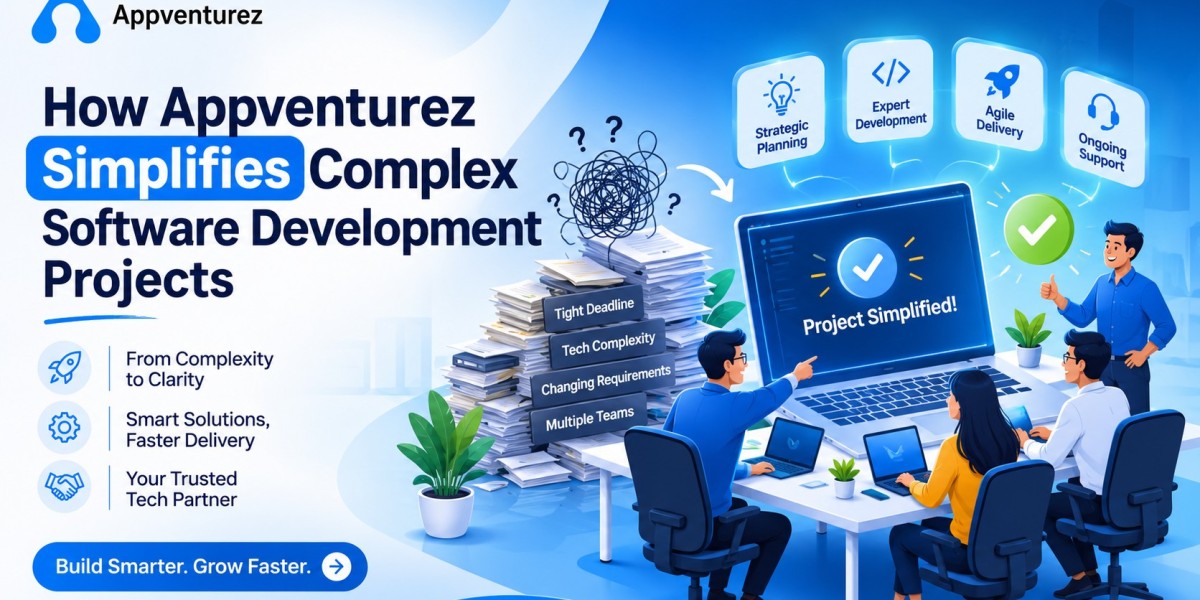

Some software projects are simple: a brochure website, a small internal tool, a single-purpose mobile app. Others are not. They involve multiple user roles, legacy systems, third-party integrations, strict compliance rules, heavy data loads, tight deadlines, and stakeholders who each want something different. These are complex software development projects, and they are where budgets overrun, timelines slip, and teams lose control.
Complexity cannot always be removed, but it can be managed. The difference between a project that spirals and one that succeeds is usually not the difficulty of the problem. It is the discipline of the process, the quality of the architecture, and the clarity of communication around it.
This guide explains how Appventurez approaches complex software development projects, and how a structured, transparent, and technology-aware partner can break overwhelming problems into manageable, predictable steps.
Note: Company figures and service descriptions should be confirmed on Appventurez’s official website before you rely on them for a purchasing decision.
What Makes a Software Project Complex?
Complexity comes from many directions at once. Common sources include:
Large or unclear scope. Many features, changing requirements, and competing priorities.
Multiple stakeholders. Different departments, users, or clients with conflicting needs.
Legacy systems. Older platforms with poor documentation, outdated technology, or fragile integrations.
Integrations. Connections to ERP, CRM, payment systems, data warehouses, and external APIs.
Scale and performance demands. High traffic, large datasets, real-time processing, or global users.
Security and compliance. Regulations in healthcare, finance, education, or government.
Advanced technology. AI, machine learning, IoT, or data engineering added to traditional software.
Distributed teams. Multiple locations, time zones, and vendors.
Tight deadlines and budgets. Pressure that encourages shortcuts.
When several of these combine, a project can become unpredictable. A team that treats it like a simple build will almost certainly struggle.
Why Complex Projects Fail
Understanding common failure patterns shows what a good process must prevent.
Unclear requirements. Teams start building before they understand the problem, then discover gaps late.
Scope creep. Features are added continuously without adjusting time, budget, or priorities.
Weak architecture. Quick decisions at the start create a tangled system that is hard to change.
Poor communication. Stakeholders and developers hold different assumptions, and problems surface too late.
Underestimated integration work. Connecting to legacy or third-party systems takes far longer than expected.
Insufficient testing. Defects, performance issues, and security gaps appear after launch.
Lack of ownership. No one is clearly accountable for decisions, risks, or quality.
Big-bang delivery. The team works for months without showing anything, so feedback arrives too late to matter.
Simplifying a complex project means designing a process that addresses each of these failure modes directly.
About Appventurez
Appventurez is a technology company that helps startups, SMEs, and enterprises build intelligent applications and AI-powered digital products.
Company snapshot
AI practice highlights: 100+ AI-driven products, 50+ certified AI engineers, 30+ industries, 38+ countries covered, and a 97% client satisfaction rate (as stated on the company’s AI development page)
Its capabilities span AI strategy, machine learning, Generative AI, LLM applications, AI agents, computer vision, NLP, intelligent automation, and integration with existing enterprise ecosystems through APIs, cloud platforms, and data systems. That breadth matters for complex projects, where one problem often touches several disciplines.
How Appventurez Simplifies Complexity: The Core Principles
Rather than relying on heroics, a reliable approach to complex development rests on a few consistent principles.
Principle 1: Understand Before Building
Complexity multiplies when requirements are unclear. A structured discovery phase clarifies goals, users, constraints, and risks before significant money is spent.
Principle 2: Break Big Problems into Small Ones
Large systems become manageable when divided into modules, phases, and sprints, each with a clear purpose and measurable outcome.
Principle 3: Design Architecture for Change
A flexible foundation absorbs new requirements, integrations, and growth without forcing a rewrite.
Principle 4: Make Progress Visible
Frequent demos, shared dashboards, and honest reporting reduce surprises and keep stakeholders aligned.
Principle 5: Automate What Can Be Automated
Testing, builds, and deployments handled by pipelines are faster and more reliable than manual steps.
Principle 6: Manage Risk Continuously
Risks are identified early, tracked openly, and addressed before they become crises.
Principle 7: Plan for Life After Launch
Support, monitoring, and iteration are part of the plan from the start, not an afterthought.
Step-by-Step: How Appventurez Approaches a Complex Project
Step 1: Discovery and Requirement Analysis
The first goal is clarity. The team works with stakeholders to document:
Business objectives and success metrics
User roles, journeys, and pain points
Functional and non-functional requirements
Existing systems, data sources, and integration points
Compliance and security obligations
Constraints in budget, timeline, and resources
Risks and unknowns
The output is a shared understanding captured in a requirements document, a prioritized feature list, and a risk register. This stage often prevents the costliest mistakes, because assumptions are challenged before they become code.
Step 2: Scope Prioritization and Phased Roadmap
Not everything needs to be built at once. Features are ranked by business value, user impact, effort, and dependency, often using methods such as MoSCoW (must, should, could, will not) or value-versus-effort matrices.
The result is a phased roadmap:
Phase 1: the core capabilities that deliver value and validate assumptions
Phase 2: extensions and integrations
Phase 3: optimization, advanced features, and scale
Phasing turns one enormous project into a series of smaller, lower-risk deliveries, each producing working software and real feedback.
Step 3: Architecture and Technical Planning
Architecture is where complexity is either tamed or locked in. The team evaluates:
Monolith, modular monolith, or microservices based on actual needs, not trends
API-first design to connect web, mobile, and third-party systems
Data models, storage, and caching strategies
Cloud platform choices on AWS, Microsoft Azure, or Google Cloud
Security architecture, identity, and access control
Scalability, availability, and disaster recovery
Observability, including logging, metrics, and alerts
The goal is not the most sophisticated design, but the simplest one that meets present needs and leaves room to grow. Decisions and their reasoning are documented so the whole team understands why the system looks the way it does.
Step 4: Modular Design and Reusable Components
A modular system is easier to build, test, and change. By separating responsibilities into well-defined components with clear interfaces, teams can:
Work in parallel without stepping on each other
Test components independently
Replace or upgrade parts without disrupting the whole
Reuse components across products and features
Isolate failures and reduce risk
Design systems for the user interface follow the same logic, keeping the experience consistent as the product grows.
Step 5: Agile Delivery in Short, Visible Sprints
Agile development breaks work into short iterations, usually two weeks, each ending with working software that stakeholders can see and test. For complex projects this brings major benefits:
Early feedback. Problems are found in weeks, not months.
Controlled change. New requirements are prioritized into the backlog instead of disrupting the plan.
Predictability. Velocity and burndown data show real progress.
Stakeholder confidence. Regular demos replace long silences.
A typical sprint cycle includes planning, daily stand-ups, development, testing, a demo, and a retrospective to improve the process.
Step 6: Handling Integrations and Legacy Systems
Integration is one of the most underestimated sources of complexity. A careful approach includes:
Mapping every system, data flow, and dependency early
Reviewing API documentation, data quality, and access constraints
Building integration layers or adapters so the new system is not tightly bound to old ones
Using staged migration, such as the strangler pattern, to replace legacy functionality gradually
Testing integrations continuously, not only at the end
Planning fallbacks for when external systems fail
The aim is to modernize without disrupting the operations the business depends on.
Step 7: Automation, DevOps, and CI/CD
Manual processes multiply risk as projects grow. Automation keeps quality high and releases predictable:
Continuous integration to build and test code with every change
Automated unit, integration, and regression tests
Continuous delivery pipelines for consistent deployments
Infrastructure as code for repeatable environments
Containerization and orchestration with tools such as Kubernetes
Monitoring and alerting for performance, errors, and cost
Teams that automate spend less time on repetitive work and more on solving real problems.
Step 8: Quality Assurance and Security Throughout
Quality is built in at every stage rather than checked at the end. Practices include:
Test planning from the first sprint
Code reviews and static analysis
Automated and manual functional testing
Performance and load testing for expected peaks
Security testing, vulnerability scanning, and secure coding standards
Data protection, access control, and compliance checks
User acceptance testing with real stakeholders
Finding a defect in a sprint costs far less than finding it in production.
Step 9: Risk and Change Management
Complex projects always encounter surprises. What matters is how quickly they are noticed and handled. Good practice includes:
A living risk register with owners, likelihood, impact, and mitigation steps
Regular risk reviews in sprint and steering meetings
A clear change-request process that evaluates impact on scope, cost, and schedule
Escalation paths so blockers reach decision makers quickly
Contingency buffers for the most uncertain work
Step 10: Launch, Support, and Continuous Improvement
A structured launch reduces risk through staged rollouts, rehearsed deployments, rollback plans, and monitoring dashboards. After launch, the team provides:
Bug fixing and performance tuning
Monitoring and incident response
User feedback analysis
Feature enhancements from the roadmap
Infrastructure and cost optimization
Documentation and knowledge transfer
Communication and Transparency: The Hidden Simplifier
Most complexity is human, not technical. Clear communication removes confusion and builds trust.
Single point of accountability. A project manager or delivery lead coordinates communication, risks, and priorities.
Regular rhythm. Daily stand-ups, sprint demos, weekly updates, and monthly steering reviews keep everyone aligned.
Shared tools. Access to backlogs, boards, repositories, and test results through tools such as Jira, GitHub, or GitLab lets clients see real status at any time.
Plain language. Technical decisions are explained in terms of business impact, so non-technical stakeholders can participate.
Honest reporting. Delays and risks are raised early, with options for recovery.
Documentation. Decisions, architecture, and processes are recorded so knowledge does not depend on individuals.
Where AI Helps Simplify Software Projects
Because Appventurez has a dedicated AI practice, intelligence can be applied both inside the product and inside the delivery process.
AI inside the product
Intelligent automation of repetitive workflows
AI chatbots and conversational assistants for users and employees
Document intelligence to extract and classify information from forms, invoices, and contracts
AI-powered search across large knowledge bases using Retrieval-Augmented Generation (RAG)
Predictive analytics for forecasting, fraud detection, and maintenance
Recommendation engines and personalization
Computer vision and voice AI where relevant
AI in the delivery process
Modern teams increasingly use AI-assisted tools for code suggestions, test generation, documentation, and debugging. Used with human review and clear security rules, these tools can improve productivity, though they do not replace architecture, judgment, or accountability.
AI technologies in the toolkit include Python, TensorFlow, PyTorch, Scikit-learn, XGBoost, OpenAI, Claude, LLaMA, Hugging Face, LangChain, LlamaIndex, AutoGen, CrewAI, OpenCV, YOLO, AWS, Microsoft Azure, Google Cloud, Kubernetes, and MLflow.
The important principle is restraint: AI is applied where it solves a real problem, tested for accuracy and cost, and monitored after release.
Illustrative Scenarios: Taming Complexity
The following are hypothetical examples that show the approach in practice. They are not client case studies.
Scenario 1: Modernizing a legacy operations system
A logistics company runs critical processes on an aging system that few people understand. Instead of a risky full replacement, the team maps workflows, builds an API layer around the legacy core, and migrates modules one at a time, starting with the most painful. Operations continue uninterrupted while the new platform gradually takes over.
Scenario 2: A multi-role platform with many stakeholders
A healthcare organization needs a portal for patients, doctors, and administrators, each with different needs and compliance rules. Discovery workshops resolve conflicting priorities, the roadmap sequences roles by value, and role-based access and audit logging are designed in from the start.
Scenario 3: Adding AI to an established enterprise product
A SaaS company wants an assistant that answers questions from its documentation. The team prototypes a RAG-based approach, evaluates accuracy and cost, adds guardrails and monitoring, integrates it through existing APIs, and rolls it out gradually to a subset of users before wider release.
Scenario 4: Scaling a successful MVP
A startup’s MVP gains traction, and performance begins to suffer. The team profiles bottlenecks, introduces caching, refactors the most overloaded module into a separate service, and automates load testing so future growth is predictable.
Tools and Technologies That Support Complex Delivery
A reliable toolchain makes complexity visible and manageable.
Area | Examples |
Project management | Jira, Azure DevOps, Trello, Confluence |
Source control and CI/CD | GitHub, GitLab, Bitbucket, Jenkins, GitHub Actions |
Cloud platforms | AWS, Microsoft Azure, Google Cloud |
Containers and orchestration | Docker, Kubernetes |
Testing | Selenium, Cypress, JUnit, Postman, JMeter |
Monitoring and observability | Prometheus, Grafana, ELK Stack, Datadog |
AI and ML | TensorFlow, PyTorch, Hugging Face, LangChain, MLflow |
Design and collaboration | Figma, Miro, Slack, Microsoft Teams |
Tools matter less than the habits around them, but the right setup removes friction and gives everyone a shared view of reality.
Engagement Models for Complex Projects
The right commercial structure supports the right behavior.
Discovery-first: a short paid phase to define scope, architecture, estimate, and risks before the full build.
Fixed scope for defined phases: suitable when a phase has clear boundaries and acceptance criteria.
Time and material: flexible for evolving requirements, paired with transparent reporting and budget checkpoints.
Dedicated team: a stable team focused on your product, building deep knowledge over time.
Managed support: ongoing maintenance, monitoring, and improvement after launch.
The company lists a minimum project size of $10,000+ and hourly rates under $25, as stated on its profile, which makes phased engagements accessible to startups and SMEs while still suiting larger programs. Request a written estimate with assumptions before committing.
Benefits of a Structured Approach to Complexity
Reduced risk through early validation and continuous risk management
Predictable timelines and budgets thanks to phased delivery and clear estimates
Higher quality from automated testing, reviews, and security practices
Faster feedback through short sprints and frequent demos
Lower long-term cost because modular architecture is cheaper to change
Better stakeholder alignment through transparent communication
Smoother integration with existing systems and data
Scalability designed in from the beginning
Easier adoption of AI where it adds measurable value
How to Prepare Your Own Complex Project for Success
Clients can make any development partner more effective by taking these steps:
Write down the business goal. Be clear about what success looks like and how you will measure it.
Identify all stakeholders early. Include users, operations, security, legal, and finance.
Assign a decisive product owner. One empowered person should resolve conflicting priorities.
Gather documentation. Collect system diagrams, API docs, process maps, and sample data.
Be honest about constraints. Share budget limits, deadlines, compliance rules, and technical debt.
Accept phased delivery. A smaller first release teaches more than a large delayed one.
Reserve time for feedback. Attend demos and respond to questions quickly.
Plan for the long term. Budget for maintenance, improvement, and growth.
Questions to Ask Before Choosing a Partner for a Complex Project
How do you handle discovery and requirement changes?
How do you approach architecture and technical debt?
Have you worked on projects with similar integrations, compliance rules, or scale?
Who will be on my team and how stable is it?
How will I see progress, risks, and budget in real time?
What testing, security, and compliance practices do you follow?
How do you manage scope changes and what do they cost?
Who owns the source code and documentation?
What happens after launch?
Can I speak to clients with comparable projects?
Conclusion
Complex software projects are difficult, but they do not have to be chaotic. The problems that derail them, such as unclear requirements, weak architecture, scope creep, poor communication, and late testing, are predictable, and so are the practices that prevent them.
Appventurez approaches complexity with discipline: understand the problem first, break it into phases and modules, design architecture for change, deliver in visible sprints, automate quality and deployment, manage risk openly, and stay engaged after launch. Combined with applied AI capabilities and experience across many industries, this gives businesses a clearer, safer path from a tangled set of requirements to a working, scalable product.
If your next project involves legacy systems, multiple stakeholders, demanding integrations, or ambitious AI features, the right preparation and the right partner can turn complexity from a threat into a manageable plan. Start with discovery, insist on transparency, build in phases, and keep improving.