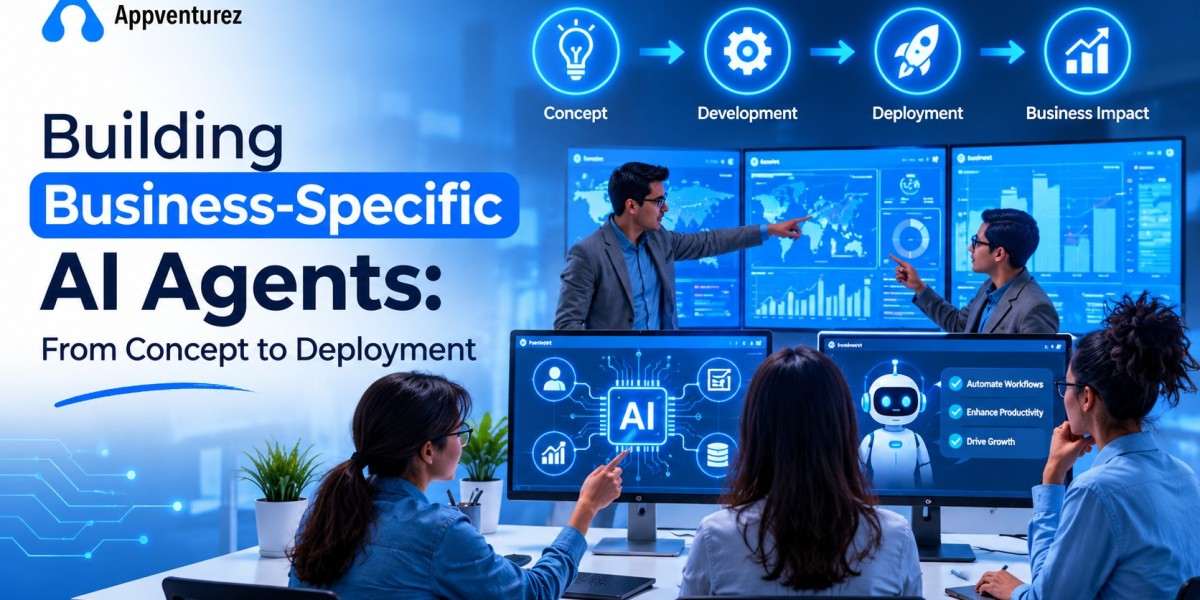

A chatbot answers questions. An AI agent gets work done. It reads a request, decides what steps are needed, calls the right tools, checks the results, and keeps going until the job is finished or it needs a human. That difference is why AI agents are moving from experiments to real business systems, handling support tickets, qualifying leads, reconciling invoices, monitoring equipment, and coordinating workflows across applications.
But generic agents rarely survive contact with a real business. Every company has its own data, rules, tools, approval chains, risks, and customers. The agents that deliver value are business-specific: designed around a particular process, grounded in company knowledge, connected to company systems, and governed by company policy.
This guide walks through how to build business-specific AI agents from concept to deployment. It covers choosing the right use case, designing architecture, grounding the agent in your data, adding tools and guardrails, testing, deploying, and improving. It also explains how agents extend into the physical world through IoT systems and into customers’ hands through iOS apps.
What Is an AI Agent?
An AI agent is a software system that uses an AI model, usually a large language model (LLM), to pursue a goal with some degree of autonomy. Compared with a simple chatbot, an agent can:
Plan. Break a goal into steps and decide the order.
Use tools. Call APIs, query databases, search documents, send messages, create records, and trigger workflows.
Remember. Keep context within a task and, where appropriate, across sessions.
Reason about results. Check outputs, handle errors, and adapt.
Escalate. Hand off to a human when confidence is low or stakes are high.
Agents range from simple single-purpose assistants to multi-agent systems in which specialized agents collaborate, such as a research agent, a drafting agent, and a review agent working under a coordinator.
What Makes an Agent Business-Specific?
A business-specific agent is shaped by the organization it serves. It differs from a generic assistant in five ways:
Grounded in your knowledge. It answers from your policies, product documentation, contracts, and records, not from general internet knowledge.
Connected to your systems. It works with your CRM, ERP, ticketing, billing, inventory, and communication tools.
Aligned with your rules. It follows your approval limits, tone of voice, compliance requirements, and escalation paths.
Measured against your goals. Success is defined in business terms such as resolution rate, handling time, cost per ticket, or revenue influenced.
Secured for your risk profile. Access, data handling, logging, and oversight match your industry and regulations.
The more specific the agent, the more reliable and valuable it tends to be.
Where Business-Specific AI Agents Create Value
The best candidates are processes that are frequent, rule-guided but messy, language-heavy, and spread across several systems.
Customer support. Agents resolve common questions, look up orders, process simple requests, and route complex cases with a full summary.
Sales and marketing. Agents research prospects, qualify leads, draft outreach, update CRM records, and schedule meetings.
Finance and operations. Agents extract data from invoices, match purchase orders, flag anomalies, and prepare reconciliation reports.
HR and internal help desks. Agents answer policy questions, assist onboarding, and handle routine requests.
IT operations. Agents triage incidents, run diagnostics, reset access, and document fixes.
Legal and compliance. Agents review documents against checklists, summarize contracts, and monitor regulatory changes, with lawyers making final decisions.
Supply chain and logistics. Agents monitor shipments, predict delays, and rebook or alert stakeholders.
Healthcare administration. Agents handle scheduling, benefits questions, and documentation support under strict privacy controls.
Industrial and IoT operations. Agents interpret sensor data, detect anomalies, recommend maintenance, and trigger work orders.
Stage 1: Define the Concept and Choose the Right Use Case
Most agent projects fail because of the wrong use case, not the wrong technology.
Start with a business problem. Identify a process with clear pain: slow response, high cost, errors, or backlog.
Evaluate candidates on four factors:
Value: time saved, cost reduced, revenue gained, or risk lowered
Feasibility: data availability, system access, and process clarity
Risk: consequences of a wrong action, regulatory exposure, and reputation impact
Measurability: whether success can be tracked with real numbers
Prefer narrow over broad. An agent that handles refund requests for one product line is easier to build, test, and trust than an agent that tries to do everything in customer service.
Define the agent’s job clearly:
What goal does it pursue?
What actions may it take on its own?
What requires human approval?
What must it never do?
How will we know it is working?
Write this as a short specification. It becomes the foundation for design, testing, and governance.
Stage 2: Map the Process and Decide the Level of Autonomy
Before building, document how the work is done today: inputs, decisions, systems touched, exceptions, and handoffs. Interview the people who do the job. Their knowledge of edge cases is invaluable.
Then decide how much autonomy the agent should have. A useful ladder:
Assistive: the agent drafts or recommends; a human acts.
Supervised: the agent acts, but a human approves each action.
Conditional autonomy: the agent acts alone within defined limits, such as refunds below a set amount, and escalates beyond them.
Full autonomy: the agent acts alone with monitoring, reserved for low-risk, well-tested tasks.
Most business agents should start at level one or two and earn more autonomy as evidence builds.
Stage 3: Design the Agent Architecture
A production agent is more than a prompt. It is a system with several parts.
The Model Layer
Choose a model that fits the task, cost, latency, and data sensitivity. Options include hosted frontier models, smaller specialized models, and open-weight models such as LLaMA that can run in your own environment. Many systems route simple tasks to smaller models and hard tasks to stronger ones.
The Orchestration Layer
This layer manages planning, tool selection, memory, and control flow. Common frameworks include LangChain, LlamaIndex, AutoGen, and CrewAI, and many teams write custom orchestration for tighter control. Whatever the choice, keep the flow understandable and observable.
The Knowledge Layer
Agents need trustworthy information. Retrieval-Augmented Generation (RAG) retrieves relevant passages from approved sources before the model responds, which grounds answers in your data and reduces fabrication. Design includes document ingestion, chunking, embeddings, a vector or hybrid search index, permissions-aware retrieval, and source citations.
The Tool Layer
Tools let the agent act. Each tool should be a well-defined function with clear inputs, outputs, and permissions, such as look up an order, create a ticket, send an email, or update a record. Apply least privilege: the agent receives only the access its job requires.
The Memory Layer
Short-term memory holds the current task state. Long-term memory may store preferences or history, with clear retention and privacy rules.
The Guardrail Layer
Guardrails validate inputs and outputs, block unsafe actions, enforce policy, redact sensitive data, and trigger escalation. They are essential, not optional.
The Observability Layer
Log every request, retrieval, tool call, decision, and outcome so behavior can be audited, debugged, and improved.
Stage 4: Prepare Your Data and Knowledge
Agent quality is bounded by data quality. Before building:
Inventory sources. Identify documents, databases, wikis, tickets, emails, and APIs the agent will need.
Clean and structure. Remove duplicates, outdated policies, and contradictions. Conflicting documents produce conflicting answers.
Assign ownership. Every knowledge source needs an owner responsible for keeping it current.
Apply access controls. Retrieval must respect who is allowed to see what, so an employee agent never reveals confidential material to the wrong person.
Protect sensitive data. Mask or exclude personal and regulated information unless it is truly required.
Prepare examples. Collect real past cases, including difficult ones, to guide design and later testing.
Stage 5: Build a Focused Prototype
Start small and prove value quickly.
Build the core loop: receive a request, retrieve knowledge, reason, call a tool, respond.
Write clear instructions. Specify role, goal, tone, boundaries, and escalation rules. Be explicit about what the agent must not do.
Define tools carefully. Use precise names, descriptions, and typed parameters, and return clear errors the agent can learn from.
Add structured outputs where downstream systems need predictable formats.
Keep a human in the loop for the first version, reviewing every action.
Test on real examples from the start, not only on easy demonstrations.
The goal of the prototype is learning: where the agent succeeds, where it fails, and what the data and tools are missing.
Stage 6: Add Guardrails, Security, and Governance
Business agents act on real data and real systems, so safety must be designed in.
Input protection. Detect prompt injection, where malicious text in an email, web page, or document tries to hijack the agent. Treat retrieved content as untrusted data, never as instructions.
Action controls. Limit tools by role, cap amounts and volumes, require approval for irreversible or high-impact actions, and use allow-lists instead of open-ended permissions.
Output checks. Validate responses for policy compliance, leakage of sensitive data, tone, and factual grounding with citations.
Identity and access. Give the agent its own identity with least-privilege credentials, and log everything it does.
Privacy and compliance. Align with laws and standards relevant to your industry and region, such as GDPR, India’s DPDP Act, HIPAA, and PCI DSS, and decide where data may be processed.
Fallbacks. Define what happens when the model is unavailable, a tool fails, or confidence is low: retry, ask a clarifying question, or hand off to a human.
Governance. Assign an accountable owner, maintain documentation, review incidents, and keep a record of model and prompt versions.
Stage 7: Evaluate and Test Thoroughly
Agents are probabilistic, so testing must be systematic and continuous.
Build an evaluation set. Collect realistic cases covering common requests, edge cases, ambiguous inputs, adversarial attempts, and out-of-scope questions.
Measure what matters:
Task success rate and accuracy
Groundedness: are answers supported by sources?
Correct tool selection and parameters
Escalation accuracy: does it hand off when it should?
Policy and safety compliance
Latency and cost per task
User satisfaction
Test the whole workflow, not just single responses, including multi-step tasks and tool failures.
Red-team the agent. Try to make it leak data, ignore rules, or take unauthorized actions.
Use human review to grade samples, especially for nuance that automatic metrics miss.
Run regression tests whenever prompts, models, tools, or data change.
Pilot with real users. Start with a small group, collect feedback, and compare results with the current process.
Stage 8: Integrate with Business Systems and Channels
An agent only creates value when it fits into how work happens.
Systems integration. Connect to CRM, ERP, ticketing, HR, finance, and data platforms through secure APIs, with clear error handling.
User channels. Deliver the agent where people already are: web chat, messaging apps, email, voice, internal portals, and mobile apps.
Workflow handoffs. Make escalation smooth, passing the full context to the human so customers never have to repeat themselves.
Notifications and audit trails. Keep stakeholders informed and decisions traceable.
Extending Agents to the Physical World: IoT-Connected AI Agents
Some of the highest-value agents work alongside sensors, machines, and connected devices. In these systems, an agent interprets streams of IoT data and turns them into decisions and actions.
Examples
A manufacturing agent that monitors vibration and temperature data, predicts a bearing failure, checks spare-part inventory, and opens a maintenance work order
A cold-chain logistics agent that watches temperature sensors in shipments and reroutes or alerts when a threshold is at risk
A smart-building agent that balances energy use based on occupancy and weather
A fleet agent that analyzes telematics, flags unsafe driving, and schedules servicing
A healthcare device agent that monitors remote patient readings and alerts clinicians
What building them involves
Device connectivity and firmware, using protocols such as MQTT, CoAP, HTTP, and Bluetooth Low Energy
Edge gateways that filter and process data locally to cut latency and bandwidth
Time-series storage and streaming pipelines
Anomaly detection and predictive models alongside the language-based agent
Digital twins to simulate and test behavior
Secure device identity, encrypted communication, and signed over-the-air updates
Dashboards and mobile apps for operators and customers
Because this work spans hardware, firmware, cloud, data science, and applications, businesses often look for an IoT app development company with real end-to-end experience. Whether you search for IoT app development services, an IoT app development agency, or IoT application development services, the right partner will understand both the device side and the intelligence layer.
What to look for in an IoT application development company
When comparing IoT application development company options, IoT application developers, or IoT software development companies, check for:
Embedded capability. A credible embedded IoT app development company can work with microcontrollers, real-time operating systems, sensors, and device firmware.
Connectivity expertise. Experience with MQTT, LoRaWAN, NB-IoT, Wi-Fi, Bluetooth, and cellular technologies.
Cloud and data skills. Familiarity with AWS IoT, Azure IoT, Google Cloud, time-series databases, and streaming platforms.
AI and analytics. The ability to add anomaly detection, forecasting, and agent-based automation on top of device data.
Security. Secure boot, device authentication, encryption, and update management.
Scalability. Proven ability to manage thousands or millions of devices.
Application layer. Strong web and mobile front-ends for monitoring and control.
Domain experience. Knowledge of your industry, whether manufacturing, logistics, energy, healthcare, or agriculture.
References. Live deployments and client feedback.
Teams searching for the best IoT app development company, the best IoT app development services, or the best IoT app development in India should look past marketing claims and request case studies, architecture walkthroughs, and a small pilot. Many global businesses choose Indian partners for Internet of Things app development services because of deep embedded and software engineering talent and competitive costs, and an experienced IoT application development services company will treat device, cloud, and agent as one system.
Putting Agents in Customers’ Hands: iOS App Development
An agent is only as useful as its interface. For many businesses, especially those serving high-value customers or field teams, that interface is an iPhone or iPad app. A well-designed mobile front-end turns an agent from a back-office tool into a daily companion.
What iOS front-ends add to an AI agent
Conversational and voice interaction that feels natural on mobile
Push notifications for proactive alerts, approvals, and updates
Device capabilities such as camera, document scanning, location, biometrics, and offline storage
Secure authentication with Face ID, Touch ID, and enterprise single sign-on
Rich, native performance and polished design that build trust
Integration with the Apple ecosystem, including widgets, Siri shortcuts, Apple Watch, and on-device machine learning
Use cases
A field-service app where technicians photograph equipment and an agent diagnoses issues and pulls repair guides
A banking app with an agent that explains transactions and helps resolve disputes
A retail app with a personal shopping agent
A healthcare app where patients ask questions and book appointments
An enterprise approvals app where managers review and authorize agent-prepared actions
An IoT companion app that lets users monitor and control connected devices with natural language
Choosing an iOS partner
Whether you want a polished consumer product or an internal tool, the right iOS App Development Company will bring Swift and SwiftUI expertise, strong UX design, secure architecture, and App Store release experience. When comparing options:
Look for an iOS App Development Company in India or elsewhere that can show live apps and ratings on the App Store.
For iOS Mobile App Development Services, confirm experience with Swift, SwiftUI, Core Data, Combine, push notifications, and integration with REST and GraphQL APIs.
A capable iOS Mobile App Development Company should also understand testing across devices and iOS versions, accessibility, and Apple’s review guidelines.
If you need a unique product, a Custom iOS App Development Company can build tailored experiences instead of template-based apps. Custom iOS App Development Services typically include discovery, design, development, testing, release, and maintenance.
Larger organizations should look for an Enterprise iOS App Development Company with experience in mobile device management, single sign-on, compliance, offline-first design, and integration with existing enterprise systems.
An iOS App Development Agency that works in agile sprints with transparent reporting will usually deliver more predictable results. Many global companies choose an iOS App Development Agency in India for strong engineering talent and cost efficiency.
If the agent will call sensitive systems, make sure the mobile app never holds privileged credentials. The app should authenticate the user, and the backend should enforce permissions.
Stage 9: Deploy with Care
Deployment is a managed rollout, not a single launch.
Choose the hosting model. Options include cloud, private cloud, on-premises, or hybrid, driven by data sensitivity, latency, and cost.
Use staged release. Start with internal users or a small percentage of traffic, then expand as metrics hold steady.
Use feature flags and kill switches so you can restrict or disable capabilities instantly.
Keep humans involved at first. Move from supervised to conditional autonomy as evidence accumulates.
Prepare operations. Define on-call responsibilities, incident procedures, and support paths.
Train users. Show people what the agent can and cannot do, how to correct it, and when to escalate.
Communicate transparently. Make clear to customers when they are interacting with an AI agent and how to reach a person.
Stage 10: Monitor, Learn, and Improve
An agent is never finished. Real usage reveals problems no test set predicted.
Monitor quality: success rate, escalation rate, groundedness, and user feedback
Monitor operations: latency, error rates, tool failures, and uptime
Monitor cost: tokens, model calls, and infrastructure per task
Monitor safety: policy violations, injection attempts, and unusual behavior
Review failures weekly, turning each into a new test case
Refresh knowledge as policies, products, and prices change
Tune prompts, tools, and retrieval based on evidence
Reevaluate models as better or cheaper options appear
Expand scope gradually, adding new tasks only after earlier ones are stable
This feedback loop, supported by MLOps practices, is what turns a promising pilot into a dependable business capability.
Technology Stack for Business AI Agents
Exact choices depend on your needs, but common components include:
Models: OpenAI models, Claude, LLaMA, and other open and proprietary LLMs
Orchestration: LangChain, LlamaIndex, AutoGen, CrewAI, or custom frameworks
Knowledge and retrieval: vector databases, hybrid search engines, and document-processing pipelines
Languages and ML libraries: Python, TensorFlow, PyTorch, Scikit-learn, Hugging Face
Cloud and infrastructure: AWS, Microsoft Azure, Google Cloud, Kubernetes, and Docker
MLOps and monitoring: MLflow, logging, tracing, and evaluation tools
Interfaces: web apps, messaging platforms, voice, iOS and Android apps
IoT layer (where relevant): MQTT brokers, edge gateways, time-series databases, and device management platforms
Choose boring, well-supported components where possible, and reserve novelty for the parts that truly differentiate your product.
Estimated Timeline and Cost
These figures are planning guides only. Actual cost depends on complexity, integrations, compliance, and team location, so request detailed estimates.
Discovery and use-case definition: about 2 to 4 weeks, often around $5,000 to $20,000
Prototype or proof of concept: about 4 to 8 weeks, often around $15,000 to $50,000
Pilot with integrations and guardrails: about 2 to 4 months, often around $40,000 to $150,000
Production deployment with monitoring and scale: 4 to 9 months or more, often $100,000 to $400,000 or higher
Ongoing operation: model usage, infrastructure, monitoring, and improvement, commonly a meaningful percentage of build cost each year
Adding IoT hardware integration, enterprise-grade security, or native mobile apps increases scope and cost.
Common Mistakes When Building Business AI Agents
Starting too broad. An agent that does everything usually does nothing reliably.
Skipping process mapping. Automating a broken process produces a faster broken process.
Ignoring data quality. Outdated or conflicting documents lead directly to wrong answers.
Over-trusting demos. Impressive demonstrations hide failure modes that real data exposes.
Granting excessive permissions. Broad access turns small errors into big incidents.
Neglecting prompt injection. Content from outside sources can manipulate an unprotected agent.
No evaluation framework. Without measurement, improvement is guesswork.
Hiding the AI. Lack of transparency damages trust.
Forgetting change management. People need training and reassurance, not surprises.
Treating deployment as the finish line. Monitoring and iteration decide long-term success.
Choosing a Partner to Build Your AI Agents
Most organizations benefit from an experienced partner, at least for the first agents. Evaluate candidates on:
Production experience with agents, RAG, and LLM applications, not just demos
Engineering depth in integration, security, cloud, and MLOps
Evaluation discipline, with a clear method for testing and measuring quality
Domain understanding of your industry and processes
Full-stack delivery, including IoT, web, and mobile where needed
Transparent process and pricing, with phased milestones
Security and compliance practices
References and case studies
Post-launch support and a plan for continuous improvement
Clear IP and data ownership terms
Start with a paid discovery or a narrow pilot to see how the team works before committing to a larger build.
Trends in Business AI Agents for 2026
Agentic workflows replace single prompts. Businesses are shifting from question-answering assistants to systems that complete multi-step tasks.
Multi-agent collaboration. Specialized agents working under coordination handle complex processes such as research, drafting, and review.
Standardized tool connections. Emerging protocols make it easier for agents to discover and use tools and data sources securely.
Smaller, specialized models. Compact models running at lower cost, and sometimes on-device, handle routine tasks.
Edge and IoT convergence. Agents increasingly interpret device data locally and act in the physical world.
Stronger governance. Evaluation, auditing, and human oversight are becoming standard buying criteria.
Voice and multimodal interaction. Agents that see documents, images, and video, and speak naturally, are expanding the range of use cases.
Mobile-first agent experiences. More agents are delivered through polished iOS and Android apps with notifications and device features.
Frequently Asked Questions
What is a business-specific AI agent?
It is an AI agent designed around a particular company’s data, tools, rules, and goals, rather than a general-purpose assistant. It is grounded in company knowledge and connected to company systems.
How long does it take to build an AI agent?
A focused prototype can take four to eight weeks. A production-ready agent with integrations, guardrails, and monitoring typically takes several months.
How much does it cost to build an AI agent for business?
Costs range from tens of thousands of dollars for a prototype to several hundred thousand for a production deployment with complex integrations, plus ongoing operating costs.
What is the difference between a chatbot and an AI agent?
A chatbot mainly answers questions in conversation. An agent plans, uses tools, takes actions in other systems, and works toward completing a goal, often across several steps.
Do AI agents replace employees?
In most business deployments, agents handle repetitive, high-volume work and support employees, who focus on judgment, relationships, and exceptions. Human oversight remains important.
How do you stop an AI agent from making mistakes?
You cannot eliminate mistakes entirely, but you can reduce and contain them through grounding in trusted data, narrow scope, guardrails, limited permissions, human approval for high-impact actions, thorough testing, and continuous monitoring.
What is RAG and why does it matter for agents?
Retrieval-Augmented Generation lets an agent retrieve relevant information from approved sources before answering, which improves accuracy, enables citations, and keeps answers current without retraining the model.
Can AI agents work with IoT devices?
Yes. Agents can interpret sensor data, detect anomalies, recommend or trigger actions, and coordinate maintenance and logistics. This usually involves an IoT application development company to handle devices, connectivity, and data pipelines.
Do I need an iOS app for my AI agent?
Not always, but a native iOS app is valuable when your audience uses iPhones and iPads, or when you need notifications, camera and biometric features, and a polished experience. An experienced iOS App Development Company can build it to connect securely to your agent backend.
How do I choose between building in-house and hiring a partner?
Build in-house if you have strong AI, data, and security skills and a clear roadmap. Choose a partner if you need speed, specialized experience, or capacity, and plan knowledge transfer so you keep long-term control.
Conclusion
AI agents are becoming a practical business tool, but success depends less on the model than on the discipline around it. The agents that work are narrow in scope at the start, grounded in trusted company knowledge, connected to the right systems, protected by guardrails, tested against real cases, and monitored after launch.
The path from concept to deployment is clear: choose a valuable and measurable use case, map the process, design a layered architecture, prepare your data, build a focused prototype, add security and governance, evaluate thoroughly, integrate with your systems and channels, deploy in stages, and improve continuously. Along the way, IoT integration can connect agents to the physical world, and native iOS apps can place them in the hands of customers and field teams.
Start small, measure honestly, earn autonomy step by step, and keep humans in the loop where the stakes are high. Businesses that follow this approach build agents that are trusted, useful, and scalable, and that turn AI from a promising demo into a lasting competitive advantage.