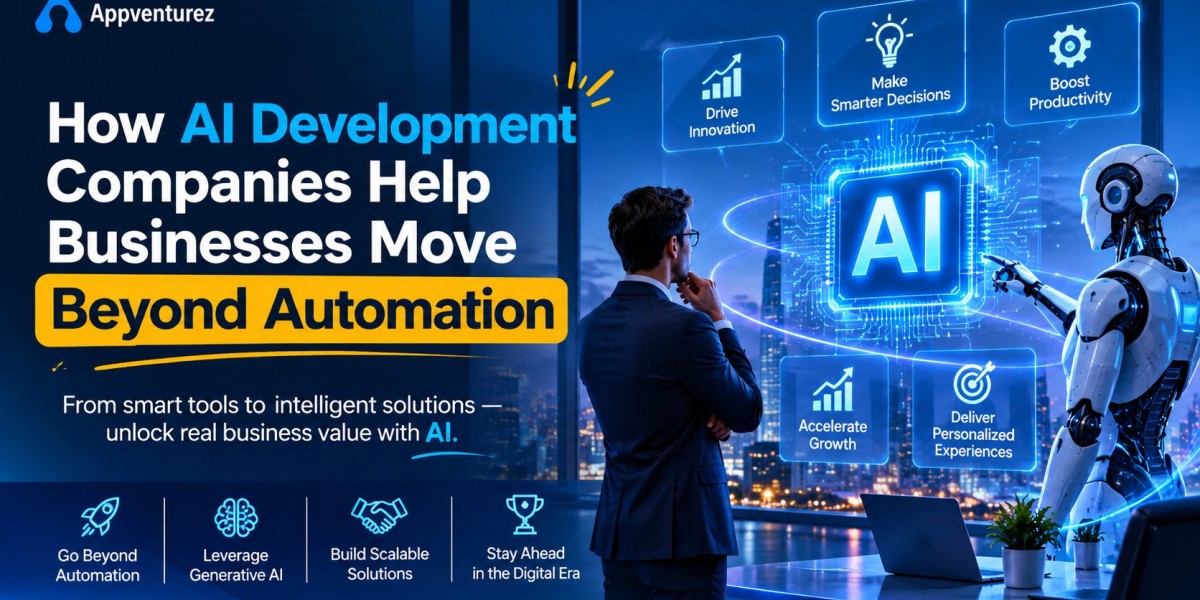

For the past two decades, automation has been the great efficiency story in business technology. Scripts replaced manual data entry. Workflow tools routed approvals. Robotic process automation clicked through screens so people did not have to. Each wave saved time and money, and each hit the same ceiling: automation can only do what someone has told it, step by step, in advance.
The moment a document looks different, a customer asks something unexpected, a sensor drifts, or conditions change, rule-based automation stalls and hands the problem back to a person. That is not a failure of the tools. It is the nature of rules. Rules are brittle where the real world is messy.
Artificial intelligence changes that boundary. Instead of following fixed instructions, AI systems learn patterns from data, handle variation, make predictions, understand language and images, personalize experiences, and increasingly take multi-step actions toward a goal. The shift is from doing tasks faster to doing things that were not possible before: predicting what will happen, understanding what a customer means, spotting what a human would miss, and adapting as conditions change.
But moving beyond automation is not as simple as buying an AI tool. It takes clear problem selection, good data, sound architecture, careful integration, strong security and governance, and a plan for operating AI systems that change over time. That is the work AI development companies do. This guide explains what "beyond automation" really means, how AI development partners help businesses get there, the use cases that matter, the role of mobile and cross-platform apps such as Flutter, special considerations in healthcare, and how to choose a partner. Companies like Appventurez build mobile, cloud, AI, IoT, and enterprise solutions, and the principles below apply to any provider you consider.
Note: Results from AI vary by business, data quality, and execution. Regulations, platforms, and pricing change quickly, so verify specifics with qualified advisors and each provider's current documentation, references, and written proposals.
Automation vs. Intelligence: What Actually Changes
It helps to be precise about the difference.
Traditional Automation
Follows explicit, predefined rules: "if X, then Y"
Works best with structured, predictable inputs
Is transparent and easy to audit
Breaks or needs manual updates when conditions change
Includes workflow engines, scripts, and robotic process automation
Intelligent Systems
Learn patterns from data instead of relying only on hand-written rules
Handle unstructured and variable inputs such as emails, images, speech, and free text
Produce predictions, classifications, recommendations, and generated content
Adapt as new data arrives, when properly monitored and retrained
Can personalize actions for each customer, patient, product, or situation
The Spectrum of "Beyond Automation"
Assisted decisions: AI suggests, a person decides
Augmented work: AI handles routine cases and flags uncertain ones
Autonomous workflows: AI completes multi-step tasks within defined limits, with oversight
New products and services: Capabilities that did not exist before, such as conversational interfaces, predictive health insights, or self-optimizing systems
In practice, the strongest solutions combine rules and AI. Rules handle policies and clear-cut steps. AI handles judgment, language, perception, and prediction. People handle exceptions and accountability.
What "Beyond Automation" Looks Like in Practice
From Reports to Predictions
Instead of a dashboard showing last month's churn, a model estimates who is likely to leave next month and why, so teams can act in time.
From Keywords to Understanding
Instead of matching keywords, NLP understands intent, sentiment, and context. An AI chatbot can answer a messy question in plain language, grounded in your own knowledge.
From Fixed Rules to Adaptive Decisions
Instead of a static fraud rule that criminals learn to evade, a model learns normal behavior and adapts as patterns shift.
From One-Size-Fits-All to Personalization
Instead of the same screen for everyone, each user sees recommendations, content, and timing tuned to their behavior and preferences, with consent.
From Manual Inspection to Perception
Instead of humans checking every item, computer vision inspects products, reads documents, and monitors environments continuously.
From Scheduled Maintenance to Predictive Care
Instead of servicing machines on a calendar, sensor data predicts which ones need attention and when.
From Tasks to Goals
Instead of scripting every step, agentic systems pursue an objective, such as resolving a support case or preparing a report, by planning steps, using tools, and checking results, within guardrails and human oversight.
How AI Development Companies Help Businesses Move Beyond Automation
A capable AI development partner contributes across the full journey, not only the model.
1. Finding the Right Opportunities
Many businesses have more AI ideas than they can fund, and some are poor fits. A good partner helps sort them.
What this involves:
Workshops and discovery to map processes, pain points, and data
Scoring ideas on value, feasibility, data readiness, and risk
Honest advice on where rules, analytics, or better process design beat AI
A prioritized roadmap, starting with high-value, low-risk wins
2. Assessing and Preparing Data
Data readiness decides most AI outcomes.
What this involves:
Auditing available data for quality, volume, freshness, and bias
Building pipelines that collect, clean, and integrate data from many systems
Labeling and annotation where supervised learning needs it
Privacy, consent, and governance design
Retrieval systems that organize documents and knowledge for language models
3. Choosing the Right Approach: Buy, Adapt, or Build
Options:
Pre-built AI services and APIs for common tasks such as speech, translation, and OCR
Pre-trained models with prompting or retrieval over your own data
Fine-tuned models adapted to your domain
Custom models for distinctive problems and proprietary data
On-device models for latency, offline use, and privacy
A good partner starts with the simplest option that could work, measures on your data, and moves up only when evidence justifies it.
4. Building and Evaluating Models Rigorously
What this involves:
Simple baselines before complex models
Proper train, validation, and test splits, with leakage prevention
Metrics tied to business outcomes, not accuracy alone
Subgroup and fairness analysis
Evaluation sets for language features that test accuracy, safety, and refusal behavior
Honest reporting of failure modes and uncertainty
5. Integrating AI Into Real Products and Workflows
A model that lives in a notebook creates no value. Integration is often the hardest part.
What this involves:
APIs and services that applications can call reliably
Embedding intelligence in mobile apps, web portals, dashboards, and enterprise systems
Fallbacks, timeouts, and human handoff for when AI is slow, wrong, or unavailable
User experience design that presents predictions, confidence, and explanations clearly
Integration with CRM, ERP, helpdesk, payment, and IoT platforms
6. Deploying and Operating AI at Scale (MLOps)
What this involves:
CI/CD for models and data, with safe rollout practices such as shadow mode and canary releases
Monitoring for drift, performance, latency, cost, and fairness
Retraining pipelines with validation gates
Versioning of data, models, prompts, and evaluation sets
Incident response and runbooks
7. Securing and Governing AI
What this involves:
Clear policies on what data reaches which model, and whether third parties may retain or train on it
Encryption, access control, secrets management, and audit logging
Defenses against prompt injection, data leakage, and unsafe tool use
Documentation of models, data sources, intended use, and limitations
Alignment with applicable regulations and recognized risk frameworks
8. Enabling Adoption and Change
AI succeeds when people use it well.
What this involves:
Involving users early, and testing prototypes with real people
Training and clear communication about what AI does and does not do
Keeping humans in the loop for high-stakes decisions
Feedback channels so users can correct the system
Measuring adoption and outcomes, not just accuracy
9. Continuous Improvement
What this involves:
Reviewing results against the original business metrics
Expanding to new use cases using shared pipelines and lessons learned
Adopting better models and tools as the field moves
Retiring features that do not deliver
High-Impact Use Cases Beyond Automation
Customer Experience
AI chatbots and virtual assistants that resolve questions, grounded in your content, with human handoff
Personalized recommendations and search
Sentiment and intent analysis to prioritize and route customer conversations
Voice interfaces and multilingual support
Operations and Supply Chain
Demand forecasting and inventory optimization
Intelligent document processing for invoices, claims, and contracts
Computer vision for quality inspection and monitoring
Route and schedule optimization
Finance and Risk
Fraud and anomaly detection
Credit and risk scoring support, with fairness and explainability
Automated reconciliation with exception handling
Sales and Marketing
Lead scoring and next-best-action
Churn prediction and retention targeting
Content and campaign optimization
IoT and Industrial
Predictive maintenance using sensor data
Anomaly detection on equipment and processes
Edge intelligence for fast, private, offline decisions
Knowledge Work
Enterprise search and question answering over internal documents
Summarization and drafting assistance, with human review
Meeting and call analysis
AI in Healthcare: Beyond Automation, With Extra Care
Healthcare shows both the promise and the responsibility of moving beyond automation. Administrative automation helps, but the larger gains come from intelligence: earlier detection, better monitoring, personalized support, and reduced documentation burden. It is also the domain where mistakes matter most, privacy rules are strictest, and regulation may apply to the software itself.
Where AI Adds Value in Healthcare Applications
Patient engagement: Virtual assistants for reminders, navigation, and questions, with clear safety limits and escalation to clinicians
Remote patient monitoring: Analysis of data from wearables and connected devices to flag concerning changes
Scheduling and operations: No-show prediction, resource forecasting, and patient flow
Clinical documentation support: Transcription and summarization, with clinician review
Medical coding and billing assistance
Triage and symptom-checking support, within carefully defined limits
Imaging and diagnostic support, which often requires rigorous clinical validation and regulatory review
Medication adherence support
What Makes Healthcare Different
Clinical safety: Errors can harm patients, so risk management and human oversight are core
Privacy and data protection: Health data is among the most protected information. Laws such as HIPAA in the United States and GDPR in Europe, along with national rules elsewhere, govern its handling
Regulation of software: Depending on intended use and claims, an app or algorithm may be regulated as a medical device
Interoperability: Integration with electronic health records using standards such as HL7 and FHIR
Clinical validation: Evidence must come from realistic clinical settings, across diverse patients
Equity and bias: Performance must be checked across demographic groups
Trust and workflow: Clinicians need tools that fit workflow and avoid alarm fatigue
This section is for general information and is not legal, regulatory, or medical advice. Consult qualified regulatory, legal, and clinical professionals for your situation.
Choosing a Healthcare App and Software Partner
Businesses building intelligent health products often search for a healthcare app development company, healthcare software development company, or custom healthcare software development company. Those that need a US-focused partner may search for a healthcare app development company USA, and should confirm how any provider, wherever located, handles US privacy requirements, hosting, and contractual protections. Whichever route you take, look for:
Shipped healthcare or wellness products, with references you can speak to
Familiarity with HIPAA, GDPR, and other relevant privacy rules, and willingness to sign appropriate data-protection agreements
Understanding of when software may be regulated as a medical device, and of quality and lifecycle standards where relevant
Experience with interoperability standards such as HL7 and FHIR
Secure development, encryption, access control, and audit logging
Clinical validation and fairness practices for AI features
Usability testing with clinicians and patients
Post-launch monitoring, incident response, and support
Healthcare app development services typically include discovery and compliance planning, UX design for patients and clinicians, native or cross-platform app development, backend and integration work, AI features, security, testing, and maintenance. Healthcare mobile app development services and healthcare mobile app development company offerings add the mobile layer: patient apps, clinician apps, and companion apps for wearables and connected devices. Healthcare application development services and mobile healthcare software development extend to web portals, dashboards, and integrations with clinical systems.
If you want to hire healthcare app developers directly, whether as a dedicated team or through staff augmentation, ask about their healthcare project history, security and privacy training, and how they will work with your clinical and compliance stakeholders.
Flutter: Bringing AI Features to Multiple Platforms Efficiently
When businesses add AI to mobile experiences, they quickly face a platform question: build separate native apps for Android and iOS, or share more code across both. Flutter, Google's open-source UI toolkit, is a widely used option for building apps for multiple platforms from a single codebase.
Why Businesses Consider Flutter
Single codebase for multiple platforms, which can reduce duplicated effort for many apps
Fast development cycles, with features such as hot reload
Consistent, customizable UI across devices
Good performance for many app types, with compiled code and a rendering engine designed for smooth animation
A large and growing ecosystem of packages and community support
Reach beyond phones, including web and desktop targets for some products
Flutter and AI Features
Flutter apps can add intelligence in several ways.
Cloud AI through APIs: Chatbots, recommendations, search, and analytics served from your backend
On-device inference: Running compact models locally using plugins and runtimes such as TensorFlow Lite or platform-native capabilities, with native integration where needed
Platform channels: Calling native Android or iOS capabilities for features that need deep device access
Speech and vision features: Voice input, camera-based recognition, and document scanning through plugins and services
Trade-Offs to Understand
Some advanced device features or platform-specific behaviors may need native code
App size and certain performance-critical scenarios deserve testing
Plugin quality varies, so dependencies need review and maintenance
Teams need Flutter and Dart skills, alongside native knowledge for edge cases
Flutter is often a strong fit for products where speed to market, consistent design, and shared code matter, such as many consumer, healthcare, and business apps. Native development can be a better fit for apps that rely heavily on cutting-edge platform features. A good partner will explain the trade-offs honestly.
Choosing a Flutter Development Partner
Businesses often search for a Flutter app development company, a Flutter mobile app development company, or a Flutter app development agency, and many consider Flutter App Development Company in India or Flutter App Development Agency in India options, or an offshore Flutter app development company, for cost efficiency. When comparing providers, including any top Flutter app development company or best Flutter app development services you find on a list, verify claims rather than relying on rankings, and look for:
Live Flutter apps on the app stores, with strong ratings and regular updates
Experience with native integration, performance tuning, and testing on real devices
Backend, cloud, and AI integration skills, not only front-end work
Security and privacy practices suited to your industry
Automated testing, CI/CD, and release management
Stable teams, transparent estimates, and clear ownership of code and accounts
A maintenance plan for Flutter and OS updates
Flutter app development services commonly include discovery and design, app development, backend and API work, AI feature integration, quality assurance, release support, and maintenance. Custom Flutter app development services, Flutter application development services, and Flutter app development solutions make sense when the app needs tailored workflows, integrations, or branded experiences rather than a template.
Engagement Models for AI Programs
How you work with a partner affects both risk and speed.
Discovery and opportunity assessment: A short, fixed-scope phase to find use cases, review data, and plan
Proof of concept or pilot: A focused project to test value on real data
Fixed-price delivery: For well-defined deliverables
Time and materials: For exploratory and evolving work
Dedicated team: A stable team that works as an extension of yours
Staff augmentation: Specialists who join your internal team
Managed services: Ongoing monitoring, retraining, and support
Many businesses combine models, such as discovery, a pilot, a dedicated team for rollout, and a support agreement for operations.
Cost Considerations
Costs vary widely, so request detailed estimates for your own project. Key drivers include:
Use case complexity and accuracy requirements
Build versus buy: Pre-built AI services lower upfront cost but add usage fees
Data readiness: Cleaning, labeling, and integration effort
Integration complexity: Legacy systems and platforms
Mobile scope: Native, Flutter, or both, and number of platforms
Infrastructure and usage fees, including per-request model costs
Security, privacy, and compliance work, which is heavier in regulated sectors
UX design and change management
Team size and location
Monitoring, retraining, and maintenance after launch
Because usage-based costs grow with success, estimate unit economics at your expected volume and at ten times that volume. A focused pilot is the best way to learn real costs and benefits before scaling.
Risks to Manage When Moving Beyond Automation
Poor data quality: Leads to unreliable predictions
Overconfidence in AI output: Language models can be fluent and wrong, so ground answers in verified data and keep humans involved in high-stakes cases
Bias and fairness: Models can reflect historical bias, which matters in hiring, lending, insurance, and healthcare
Privacy and security: New data flows and new attack surfaces, including prompt injection
Explainability: Some decisions must be justified to customers, auditors, or regulators
Model drift: Performance decays as conditions change
Cost growth: Usage-based fees rise with adoption
Vendor lock-in: Dependence on one model provider or platform
Change resistance: People may distrust or avoid tools they do not understand
Regulatory change: AI rules are evolving across regions and sectors
Common Mistakes to Avoid
Starting with the technology instead of the problem
Skipping the data assessment
Treating AI as a bolt-on rather than part of the product and workflow
No fallback plan when the model is slow, wrong, or unavailable
Launching to everyone at once without pilots and staged rollout
Ignoring security, privacy, and governance until late
Overpromising accuracy to stakeholders
Neglecting user experience and adoption
Forgetting monitoring and retraining
Underestimating ongoing costs
Choosing a partner on price alone
Why Many Businesses Choose India for AI Development
India has become one of the world's largest hubs for AI, software, and mobile development, and many businesses build intelligent products with Indian partners.
Skilled Engineering Talent
India produces thousands of engineers every year with expertise in machine learning, data science, data engineering, cloud platforms, and mobile development.
Cost-Effective Development
Compared to North America and Europe, businesses can significantly reduce development costs while maintaining high-quality standards.
Strong Technology Ecosystem
India hosts thousands of technology companies offering AI consulting, mobile and Flutter development, healthcare software, and enterprise integration.
Flexible Engagement Models
Businesses can choose from:
Dedicated development teams
Fixed-price projects
Hourly hiring
Staff augmentation
Offshore development centers
Global Project Experience
Indian companies work with clients across the US, UK, Europe, Australia, and the Middle East, making them familiar with international compliance expectations and agile project management.
Things to Manage in Offshore Work
Cross-border data-transfer rules, hosting location, access controls, and contractual protections deserve special attention, especially for healthcare and other sensitive data. Confirm where data resides and who can reach it, involve your legal and compliance teams, and agree on overlapping working hours and clear documentation from the start.
How to Choose an AI Development Partner
Use this checklist when comparing providers.
Production AI systems that have run reliably for months, with references
Honest advice on when AI is the right tool and when it is not
Strong data engineering, MLOps, and integration skills
Evaluation rigor: baselines, test sets, and measured results
Experience in your industry and with your platforms, including mobile and, where relevant, Flutter
Security, privacy, and governance discipline, with clear answers on data handling and third-party AI services
Architecture that keeps models swappable and failures contained
Transparent pricing, including usage fees and maintenance
Stable teams and open communication
Clear ownership of code, models, prompts, evaluation sets, accounts, and data
Post-launch support and continuous improvement
Begin with a paid pilot, and keep ownership of your repositories and accounts from day one.
Why Choose Appventurez as an AI Development Partner?
Editor's note: This section describes Appventurez's services in general terms. Add verified case studies, measurable results, and certifications from your own records before publishing.
When businesses want to move beyond automation, they need a partner who combines AI expertise with strong application engineering. Appventurez is a trusted software development company offering innovative mobile, cloud, AI, IoT, and wearable solutions tailored to different industries.
The company focuses on delivering scalable, secure, and business-oriented applications that help organizations automate workflows, improve customer engagement, and make smarter decisions. From predictive analytics and NLP to AI chatbots, recommendation engines, computer vision, and on-device intelligence, Appventurez builds the models along with the mobile apps, dashboards, cloud backends, and system integrations that put AI to work, with flexible engagement models including dedicated teams and ongoing support.
By leveraging modern frameworks, cloud technologies, AI capabilities, and agile methodologies, Appventurez aims to design every solution for long-term scalability, seamless integration, strong security, and measurable business outcomes. As with any provider, evaluate them against the criteria in this guide: ask for relevant case studies, probe their evaluation and security practices, speak with long-standing clients, and begin with a focused pilot.
Future Trends
The move beyond automation is accelerating, and these trends are worth watching.
Key trends include:
Agentic AI that plans and completes multi-step tasks within guardrails and human oversight
Conversational interfaces embedded in apps, devices, and enterprise tools
Smaller, efficient models running on phones, wearables, and edge devices
Multimodal AI combining text, images, audio, and sensor data
Stronger regulation and governance of AI, with growing emphasis on transparency and risk management
Better evaluation, observability, and guardrail tooling
Privacy-preserving techniques such as on-device processing and federated learning
Cross-platform frameworks such as Flutter maturing alongside on-device AI capabilities
More AI inside healthcare apps, paired with stricter validation and monitoring
Cost-efficiency becoming a core design goal
Businesses that build modular, well-governed foundations today will adopt these advances more easily.
Frequently Asked Questions
What does "beyond automation" mean?
Moving from systems that follow fixed rules to systems that learn, predict, understand language and images, personalize, and increasingly act toward goals, with human oversight.
Does AI replace automation?
No. Most strong solutions combine rules, automation, and AI, with people handling exceptions and accountability.
Where should we start?
Pick one high-value, low-risk use case with available data, run a pilot against a baseline, and expand based on evidence.
Is Flutter a good choice for AI-enabled apps?
Often yes, especially for products that benefit from shared code and consistent design. Heavily device-specific features may need native integration, and a good partner will advise.
Can AI be used safely in healthcare apps?
With careful design: strict privacy controls, clinical validation, human oversight, clear limits on advice, and attention to regulation, which varies by country and by intended use.
How long does an AI project take?
A focused pilot can take weeks to a few months, depending on data readiness and integration. Larger programs take longer.
How do we avoid vendor lock-in?
Own your repositories, accounts, and evaluation sets, keep model access behind a clean interface, and require documentation and transition support.
Conclusion
Automation made businesses faster at doing what they already did. AI lets them do what they could not do before: predict instead of react, understand instead of match, personalize instead of broadcast, perceive instead of sample, and adapt instead of wait for the next rule change. Getting there is less about buying a model than about engineering a system: choosing the right problems, preparing data, integrating intelligence into real products, operating it reliably, protecting people and data, and measuring outcomes honestly.
Whether the next step is an AI chatbot in a Flutter app, predictive insights in a healthcare platform, smarter operations, or a connected-device product, the path is the same: start small, protect what works, measure honestly, and let evidence decide how far to go. India continues to stand out as a destination for AI, mobile, and software development, offering strong engineering talent, cost-effective delivery models, and deep experience serving global clients. By partnering with an experienced development company like Appventurez, businesses can build scalable, secure, and future-ready AI solutions tailored to their specific goals.
The businesses that move beyond automation will not be the ones with the most tools. They will be the ones that learn fastest from their data and turn what they learn into better decisions, better products, and better experiences.