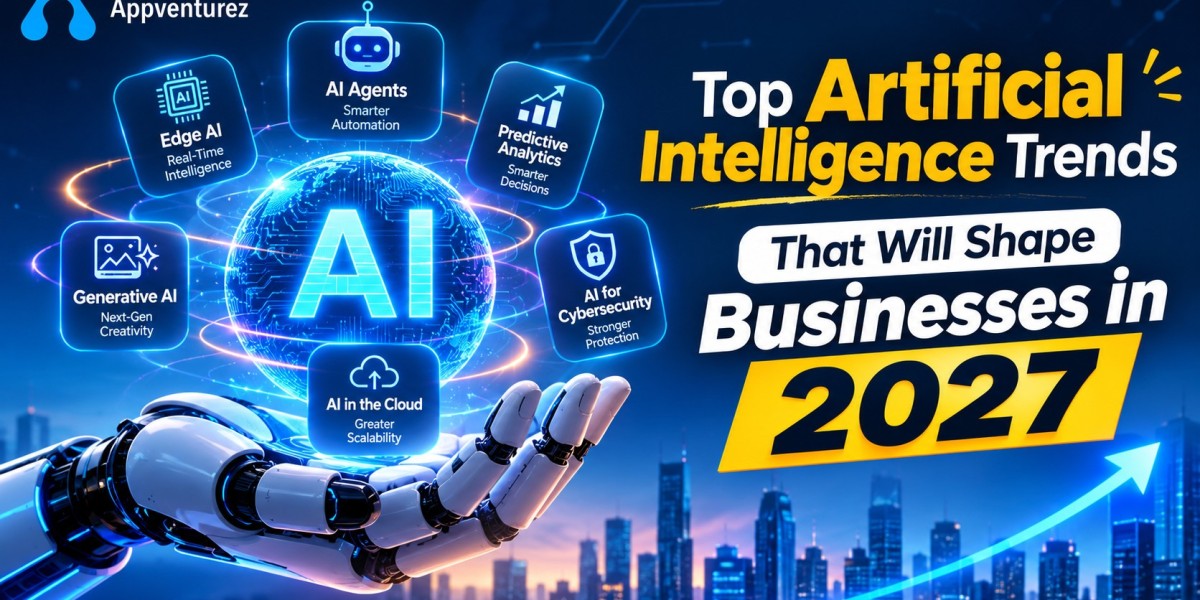

Artificial intelligence entered 2026 as a technology most businesses were still testing. It is heading into 2027 as one that many businesses depend on. The experiments of the last few years, chatbots, copilots, forecasting models, and pilots in every department, are being forced to answer harder questions: Does this save money? Does it work reliably? Is it secure? Can we explain it to a regulator? Can we afford it at scale?
The companies pulling ahead are not the ones with the most AI tools. They are the ones that have picked a few high-value use cases, built them on solid data and architecture, wrapped them in governance, and put them in front of customers and employees through the apps and devices people actually use, from phones and smartwatches to dashboards and enterprise systems.
In short: the AI trends that will matter most to businesses in 2027 are the rise of agentic AI that completes tasks, intelligence moving onto phones and wearables, smaller and more efficient models, domain-specific and multimodal AI, stronger governance and security, cost discipline, and AI-native products built around human and machine collaboration. This guide explains each trend, what it means for your business, and how to prepare, with a practical look at mobile, Android, and wearable experiences along the way. Companies like Appventurez build mobile, cloud, AI, IoT, and wearable solutions, and the guidance below applies to any partner you consider.
Quick Summary: The Top AI Trends for 2027
1. Agentic AI moves from demos to production
2. AI moves onto the device: phones, wearables, and the edge
3. Smaller, efficient, specialized models rise
4. Multimodal AI becomes the default interface
5. Domain-specific and enterprise-grounded AI
6. AI governance, regulation, and trust become board-level topics
7. AI security becomes its own discipline
8. Cost discipline and AI FinOps
9. AI-native products and workflows replace bolt-on features
10. Human and AI collaboration reshapes work and skills
11. AI-assisted software development changes how products are built
12. Data readiness and synthetic data become strategic
13. AI in health, wellness, and wearable experiences grows up
14. Sustainable and efficient AI
Trend 1: Agentic AI Moves From Demos to Production
What it is: AI agents pursue goals rather than only answering questions. They plan steps, use tools such as CRMs, helpdesks, calendars, and payment systems, check results, and escalate when needed.
Why it matters in 2027: The 2025 and 2026 wave of agent demos is giving way to production deployments in customer support, sales operations, finance back offices, IT service desks, and logistics. Businesses are discovering that value comes from narrow, well-bounded workflows rather than all-purpose assistants.
What to expect:
More multi-step workflows completed end to end, with human approval for sensitive actions
Specialized agents coordinating with one another under supervision
Standard ways for agents to connect to tools and data, reducing integration effort
Greater focus on evaluation, observability, and permissions as agents gain access to real systems
Pricing models tied to completed tasks rather than seats
How to prepare:
Pick one workflow with clear rules, available data, and recoverable errors
Define what the agent may do, may not do, and must always escalate
Run in shadow mode before it acts on real cases
Measure resolution and satisfaction, not just deflection
Trend 2: AI Moves Onto the Device: Phones, Wearables, and the Edge
What it is: Instead of sending every request to the cloud, devices run models locally. Smartphones, smartwatches, earbuds, cameras, vehicles, and industrial equipment increasingly include dedicated AI hardware.
Why it matters in 2027: On-device AI offers lower latency, offline operation, better privacy, and lower cloud costs. As hardware improves and models shrink, more features, such as voice, vision, summarization, and activity recognition, can run locally.
What to expect:
Hybrid designs where a small on-device model handles quick or private tasks and the cloud handles heavy reasoning
Mobile apps that remain useful offline
Privacy-forward features that keep raw audio, images, and health signals on the device
More capable wearables that interpret signals locally and sync insights to a companion app
What This Means for Android and Mobile Apps
Android's reach across price points and regions makes it a central platform for on-device AI. Businesses planning AI features should consider:
What runs on-device versus in the cloud, based on latency, privacy, battery, and cost
Device fragmentation: Performance varies widely across Android models, so test on a representative set of real devices
Battery and memory limits, which shape model size and scheduling
Permissions and consent for camera, microphone, location, and health data
Platform and policy updates, which arrive regularly and affect background behavior
Businesses seeking an Android app development company to build AI-enabled products should look for teams that combine native Android skill with ML and cloud capability. A strong Android application development company or Android mobile app development company will treat intelligence as part of the product experience rather than a bolt-on. When comparing options, including the top Android app development company or top Android app development companies named on any list, or searching for the best Android app development company for your needs, treat rankings as a starting point and verify through references, live apps, and a pilot. A good Android app development agency will advise honestly on what to run on-device, what to run in the cloud, and what not to build.
Android app development services typically include discovery and design, native Android development, backend and API work, AI integration, quality assurance on real devices, Play Store release support, and ongoing maintenance. Custom Android app development services make sense when AI is central to the product and needs deep integration with your data. Many businesses also consider an Android app development company in India or an Android app development agency in India for cost-efficient delivery, with data-handling and security expectations agreed up front.
What This Means for Wearables and Smartwatches
Wearables are among the clearest beneficiaries of on-device AI: small, always on the body, rich in sensor data, and constrained by battery.
Glanceable intelligence: Short, timely insights and prompts rather than long interactions
Local signal processing: Activity, sleep, and anomaly detection running on the device or paired phone
Hands-free interaction: Voice commands and quick replies
Enterprise uses: Worker safety alerts, task prompts, and approvals for field and warehouse teams
Privacy and regulation: Health and location data require clear consent, strong protection, and, for some health claims, regulatory review
Businesses exploring these experiences often search for a wearable app development company, a wearable mobile app development company, a smartwatch app development company, or a wearable app development agency, and many consider a wearable app development company in India or a wearable app development agency in India for cost efficiency. Look for shipped wearable apps, Wear OS and watchOS experience, strong small-screen UX, companion-app and cloud capability, privacy discipline, and testing on real hardware.
Wearable app development services and wearable application development services commonly include UX design for small screens, smartwatch and companion-app development, sensor and device integration, AI and cloud integration, and maintenance. Custom wearable app development services, wearable mobile app development services, and smartwatch app development services make sense when the wearable experience is central to the product. Companies that want to extend an existing team can hire wearable app developers as a dedicated team or through staff augmentation.
Trend 3: Smaller, Efficient, Specialized Models Rise
What it is: Not every task needs the largest model. Smaller models, tuned for specific tasks, are increasingly capable, cheaper, faster, and easier to run privately or on-device.
Why it matters in 2027: Costs of large-model usage add up at scale. Businesses are adopting model routing, using small models for routine requests and larger ones only for hard problems, and fine-tuning compact models on their own data.
What to expect:
Model portfolios rather than a single model for everything
More private and on-premises deployments of open-weight models where privacy or cost justify them
Distillation and compression techniques that shrink models while keeping most of their ability
Greater emphasis on evaluation to choose the right model for each task
How to prepare: Keep model access behind a clean interface, maintain your own evaluation sets, and design so models can be swapped as the market changes.
Trend 4: Multimodal AI Becomes the Default Interface
What it is: Models that understand and generate text, images, audio, video, and sensor data together.
Why it matters in 2027: People do not communicate in text alone. They point a camera at a problem, speak a request, share a screenshot, or describe a symptom. Multimodal AI makes these natural interactions possible and opens new use cases in inspection, support, accessibility, and field work.
What to expect:
Voice-first assistants in apps, vehicles, and wearables
Camera-based support and troubleshooting
Document and image understanding embedded in workflows
Richer analytics that combine text, images, and signals
How to prepare: Identify processes that already involve images, calls, or documents, and test multimodal approaches against your own data, with attention to privacy and consent.
Trend 5: Domain-Specific and Enterprise-Grounded AI
What it is: AI tuned to an industry or grounded in a company's own knowledge, rather than relying on general internet knowledge alone.
Why it matters in 2027: General models know a little about everything and a lot about nothing specific to your business. Retrieval over your documents, fine-tuning on your data, and industry-specific models improve accuracy and reduce errors.
What to expect:
Retrieval-augmented systems as a standard pattern for enterprise assistants
Industry-specific models for healthcare, finance, legal, manufacturing, and retail, with domain validation
Greater attention to data quality, permissions, and freshness in knowledge bases
Proprietary data becoming a competitive advantage
How to prepare: Invest in organizing and governing your knowledge and data, with access controls that respect who may see what.
Trend 6: AI Governance, Regulation, and Trust Become Board-Level Topics
What it is: Growing expectations, and in some regions legal requirements, around how AI systems are built, documented, tested, and overseen.
Why it matters in 2027: Regulators in several regions are phasing in AI rules, with obligations that vary by risk level and use case, and timelines that have been subject to adjustment. Customers, partners, and auditors are also asking harder questions about data use, fairness, and accountability.
What to expect:
Risk-based approaches to AI regulation, with stricter requirements for high-impact uses such as credit, hiring, healthcare, and safety
Demand for documentation: intended use, data sources, evaluation results, and limitations
Adoption of recognized frameworks and management standards for AI risk and governance
Human oversight requirements for consequential decisions
Transparency obligations, such as disclosing when people are interacting with AI
How to prepare: Maintain an inventory of AI systems, assign owners, document decisions, test for fairness and robustness, and involve legal and compliance teams early. Regulations vary by country and change over time, so consult qualified advisors.
Trend 7: AI Security Becomes Its Own Discipline
What it is: Protecting AI systems, and protecting businesses from AI-enabled attacks.
Why it matters in 2027: As agents gain access to tools and data, new attack surfaces appear: prompt injection, data leakage, manipulated retrieval content, and misuse of permissions. At the same time, attackers use AI for more convincing phishing, deepfakes, and fraud.
What to expect:
Standard practices for least-privilege access for agents and tools
Treating external content as untrusted input to models
Red-teaming and adversarial testing as part of release processes
AI-assisted defense: anomaly detection, automated triage, and faster response
Stronger identity verification to counter synthetic media
How to prepare: Build security into AI architecture from the start, restrict what agents can do, log every action, and test for attacks before launch.
Trend 8: Cost Discipline and AI FinOps
What it is: Managing the real cost of AI, particularly usage-based costs that scale with adoption.
Why it matters in 2027: Early pilots were cheap because few people used them. Scaling to thousands of users and millions of requests can turn a modest experiment into a large recurring bill. Finance leaders are asking for unit economics.
What to expect:
Tracking cost per resolved task, per conversation, or per prediction
Model routing, caching, and prompt efficiency as standard practice
On-device and smaller-model strategies to cut cloud spend
Budgets, alerts, and showback for AI usage by team and product
Business cases that account for the full lifecycle, including monitoring, retraining, and support
How to prepare: Estimate unit costs at your expected volume and at ten times that volume, and design so you can change models and architectures when economics shift.
Trend 9: AI-Native Products and Workflows Replace Bolt-On Features
What it is: Products designed around AI from the start, rather than traditional software with a chatbot added.
Why it matters in 2027: Customers increasingly expect intelligence to be woven into the experience: search that understands intent, interfaces that adapt, and workflows that complete themselves. Businesses that redesign processes around AI, instead of adding it on top of old ones, tend to see larger gains.
What to expect:
Conversational and voice interfaces alongside, and sometimes replacing, menus and forms
Dynamic, personalized user experiences
Workflows redesigned around human and AI collaboration
New business models, such as outcome-based services
How to prepare: Re-examine core journeys: what would they look like if the system understood the customer's goal and could act on it? Prototype before committing, and keep fallbacks for when AI fails.
Trend 10: Human and AI Collaboration Reshapes Work and Skills
What it is: AI takes on routine and drafting work, while people focus on judgment, relationships, creativity, and accountability.
Why it matters in 2027: The question is shifting from "will AI replace jobs?" to "how do roles change, and how do we train for them?" Organizations that invest in AI literacy, clear human-in-the-loop design, and change management see higher adoption and better outcomes.
What to expect:
New skills: prompt and workflow design, evaluation, supervision of AI output, and data literacy
Roles focused on overseeing and improving AI systems
Greater scrutiny of fairness and impact on employees
Training programs and clear policies on acceptable AI use
How to prepare: Involve employees early, be transparent about goals, train people to work with AI, and measure adoption alongside accuracy.
Trend 11: AI-Assisted Software Development Changes How Products Are Built
What it is: AI tools that help write, review, test, and document code, and increasingly handle multi-step engineering tasks.
Why it matters in 2027: Development teams are using AI to speed up routine work, from boilerplate and tests to migrations and documentation. The benefit is real when paired with strong review, testing, and security practices, and risky when generated code is accepted without scrutiny.
What to expect:
Faster prototyping and iteration
Greater emphasis on code review, automated testing, and security scanning
Policies on code ownership, licensing, and sensitive data in AI tools
A shift in engineering effort toward architecture, requirements, and verification
How to prepare: Measure whether AI tools improve delivery and quality in your context, and keep human accountability for what ships.
Trend 12: Data Readiness and Synthetic Data Become Strategic
What it is: Treating data as a product: clean, governed, documented, and accessible, supplemented where needed by synthetic data.
Why it matters in 2027: The biggest blocker to AI value is still data: scattered, inconsistent, poorly labeled, or restricted. Organizations that invest in data foundations move faster on every AI use case. Synthetic data helps where real data is scarce or sensitive, though it must be validated carefully.
What to expect:
Unified data platforms and clear data ownership
Data quality monitoring as a routine practice
Synthetic data used for testing, augmentation, and privacy-preserving development
Privacy-enhancing techniques such as federated learning and on-device processing
How to prepare: Assess data readiness for your top use cases, fix the biggest gaps, and establish governance for access, quality, and consent.
Trend 13: AI in Health, Wellness, and Wearable Experiences Grows Up
What it is: More capable, personalized insights from phones, wearables, and connected devices, along with AI assistants for patients and clinicians.
Why it matters in 2027: Sensors and on-device AI make continuous, personalized insights possible. But health is also the area where accuracy, privacy, fairness, and regulation matter most.
What to expect:
Richer wellness and monitoring features on smartwatches and companion apps
AI assistants for scheduling, reminders, documentation, and navigation, with clear safety limits
Stricter expectations for clinical validation and subgroup performance
Continuing attention to regulation of software that makes medical claims
How to prepare: Involve clinical and regulatory advisors early, design for consent and data minimization, and keep humans responsible for care decisions. This is general information and not medical, legal, or regulatory advice.
Trend 14: Sustainable and Efficient AI
What it is: Attention to the energy, water, and hardware footprint of AI, and to efficiency as both a cost and a reputational issue.
Why it matters in 2027: Large-scale AI uses significant computing resources. Businesses face pressure from customers, investors, and regulators to account for environmental impact, and efficiency also lowers cost.
What to expect:
Smaller models, efficient inference, and on-device processing as sustainability levers
Measurement and reporting of AI-related energy use
Hardware and cloud choices that weigh efficiency
Right-sizing models to tasks
How to prepare: Include efficiency in architecture decisions, track usage, and avoid using large models where small ones will do.
What These Trends Mean by Business Function
Customer Support
Agents resolve routine requests end to end, multimodal and voice support grows, and on-device assistants extend support into apps and wearables, all under stronger governance.
Sales and Marketing
Agents qualify leads, research accounts, and keep CRMs current, while personalization becomes more real-time and more privacy-conscious.
Operations and Supply Chain
Predictive and agentic systems coordinate across systems, IoT and edge AI feed real-time decisions, and computer vision monitors quality and safety.
Finance and Risk
Document intelligence, anomaly detection, and fraud defenses advance, with strict explainability, fairness, and audit requirements.
HR and Internal Services
Employee assistants and onboarding automation spread, with careful fairness controls and human accountability.
Product and Engineering
AI-native product design and AI-assisted development reshape how software is built and tested.
Healthcare and Life Sciences
Patient engagement, monitoring, and documentation tools grow, paired with rigorous validation and privacy practices.
How to Prepare Your Business for 2027: A Practical Roadmap
1. Anchor on Business Outcomes
Choose a few use cases tied to measurable goals, such as resolution rate, cost per transaction, conversion, or cycle time, with baselines.
2. Build Data Foundations
Assess quality, access, and governance. Fix the gaps that block your top use cases.
3. Start With Pilots, Not Programs
Run focused pilots with shadow mode and real users, and scale only what the evidence supports.
4. Design Architecture for Change
Keep models behind clean interfaces, use modular components, and plan fallbacks. Assume the best model today will not be the best model next year.
5. Put Governance in Place Early
Inventory AI systems, assign owners, document intended use and limitations, and involve legal, security, and compliance teams.
6. Secure by Design
Apply least privilege to agents and tools, treat external content as untrusted, log actions, and test adversarially.
7. Control Cost
Track unit economics, route requests to appropriately sized models, and use on-device options where they fit.
8. Meet Users Where They Are
Deliver AI through the mobile apps, wearables, and channels your customers and employees already use.
9. Invest in People
Train teams to work with AI, define clear human-in-the-loop roles, and communicate openly about goals and limits.
10. Choose Partners Carefully
Select partners with production experience, honest advice, strong engineering, and clear ownership terms.
Choosing a Technology Partner for the AI Era
When evaluating any AI and app development partner, look for:
AI systems running in production, with references and measured results
Honest advice on when AI is the right tool and when simpler options win
Strong application engineering across Android, iOS, wearables, web, and backend
Evaluation rigor: baselines, test sets, and monitoring
Security, privacy, and governance discipline, with clear answers on data handling and third-party AI services
Architecture that keeps models swappable and failures contained
Transparent pricing, including usage fees and a three-year cost view
Stable teams and open communication
Clear ownership of code, models, prompts, evaluation sets, accounts, and data
Post-launch support and continuous improvement
Begin with a paid pilot, and keep ownership of your repositories and accounts from day one.
Why Many Businesses Choose India for AI, Mobile, and Wearable Development
India has become one of the world's largest hubs for software, mobile, AI, and wearable development.
Skilled Engineering Talent
India produces thousands of engineers every year with expertise in machine learning, mobile development, cloud platforms, data engineering, and embedded systems.
Cost-Effective Development
Compared to North America and Europe, businesses can significantly reduce development costs while maintaining high-quality standards.
Strong Technology Ecosystem
India hosts thousands of technology companies offering AI consulting, Android and iOS development, wearable development, and enterprise integration.
Flexible Engagement Models
Businesses can choose from:
Dedicated development teams
Fixed-price projects
Hourly hiring
Staff augmentation
Offshore development centers
Global Project Experience
Indian companies work with clients across the US, UK, Europe, Australia, and the Middle East, making them familiar with international compliance expectations and agile project management.
Things to Manage in Offshore Work
Cross-border data-transfer rules, hosting location, access controls, and contractual protections deserve special attention. Confirm where data resides and who can reach it, involve legal and security teams, and agree on overlapping working hours and clear documentation from the start.
Why Choose Appventurez for AI, Mobile, and Wearable Solutions?
Editor's note: This section describes Appventurez's services in general terms. Add verified case studies, measurable results, and certifications from your own records before publishing.
When businesses want to turn AI trends into working products, they need a partner who combines AI expertise with strong mobile, wearable, and cloud engineering. Appventurez is a trusted software development company offering innovative mobile, cloud, AI, IoT, and wearable solutions tailored to different industries.
The company focuses on delivering scalable, secure, and business-oriented applications that help organizations automate workflows, improve customer engagement, and make smarter decisions. From NLP and AI chatbots to agent-style assistants, predictive analytics, and recommendation engines, Appventurez builds the intelligence along with the Android and iOS apps, wearable and smartwatch experiences, dashboards, cloud backends, and system integrations that put it to work, with flexible engagement models including dedicated teams and ongoing support.
By leveraging modern frameworks, cloud technologies, AI capabilities, and agile methodologies, Appventurez aims to design every solution for long-term scalability, seamless integration, strong security, and measurable business outcomes. As with any provider, evaluate them against the criteria in this guide: ask for relevant case studies, probe their evaluation and security practices, speak with long-standing clients, and begin with a focused pilot.
Frequently Asked Questions
What are the biggest AI trends for businesses in 2027?
Agentic AI in production, on-device and wearable intelligence, smaller and specialized models, multimodal interfaces, stronger governance and security, cost discipline, and AI-native products and workflows.
What is agentic AI?
AI systems that pursue goals by planning steps, using tools, and checking results, within guardrails and human oversight, rather than only answering questions.
Why is on-device AI important?
It offers lower latency, offline operation, better privacy, and lower cloud costs, and it makes intelligent features practical on phones and wearables.
How should a small or mid-sized business start with AI?
Pick one high-value, low-risk use case with available data, run a pilot against a baseline, and expand based on evidence.
Do we need a mobile app or wearable strategy for AI?
Not always, but mobile and wearables are where many customers and employees interact with businesses, so they are often the best place to deliver AI value.
How do we prepare for AI regulation?
Keep an inventory of AI systems, document purpose and limits, test for fairness and robustness, keep humans accountable for consequential decisions, and consult qualified legal advisors, since rules vary by region and change over time.
How do we control AI costs?
Track cost per resolved task or prediction, route requests to right-sized models, cache where safe, and use on-device processing where it fits.
How do we avoid vendor lock-in?
Own your repositories, prompts, and evaluation sets, keep model access behind a clean interface, and require documentation and transition support.
Conclusion
The AI story of 2027 is less about spectacular new capabilities and more about maturity: agents that finish tasks, intelligence that lives on the devices people carry and wear, models sized to their jobs, interfaces that see and hear as well as read, governance and security that earn trust, and cost discipline that keeps programs sustainable. Businesses that thrive will start with outcomes, build on solid data and flexible architecture, keep humans accountable where it matters, and deliver AI through the apps and devices customers and employees actually use.
India continues to stand out as a destination for software, mobile, AI, and wearable development, offering strong engineering talent, cost-effective delivery models, and deep experience serving global clients. By partnering with an experienced development company like Appventurez, businesses can turn the trends above into scalable, secure, and future-ready solutions tailored to their specific goals.
Whether you plan an AI agent for support, on-device intelligence in an Android app, a smartwatch companion for field teams, or a governance program that lets you scale with confidence, the best time to begin is with one well-chosen use case, proven small and improved with evidence.